|
July 26, 2007
I had coffee with the two other 2007 Adelaide Festival of Ideas bloggers (Tim Dunlop and Kerryn Goldsworthy) today at the SA Art Gallery coffee shop. It was like meeting old friends who enjoyed being in one another's company and talking about politics and art (literature).
This is a capital city that has yet to fully embrace blogging or an online world including, sad to say, the Arts Festival crowd. This piece by Sophie Cunningham in The Age stands in marked contrast to the indifference and hostility to blogging and the internet.
On the walk into the SA Art Gallery I took a few photos of old graceful Adelaide--pre-internet Adelaide if you like---from within the shadows:
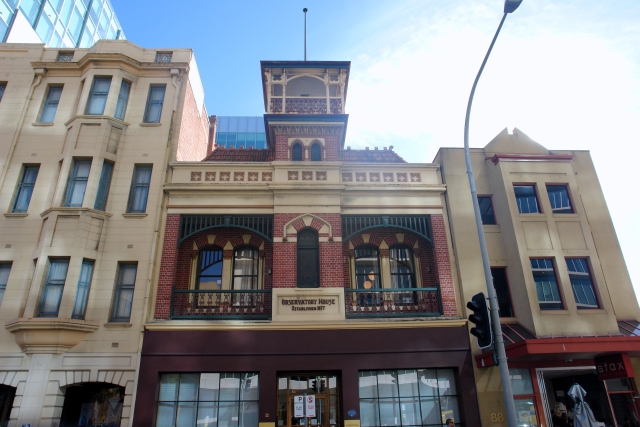
Gary Sauer -Thompson, Observatory House, Adelaide CBD, 2007
I do not understand the resistance to blogging --somehow it appears to threatens people's identity even though it opens up spaces for people's creativity. Photography is an example. My explorations of the urban life I live can be shared with readers and viewers.
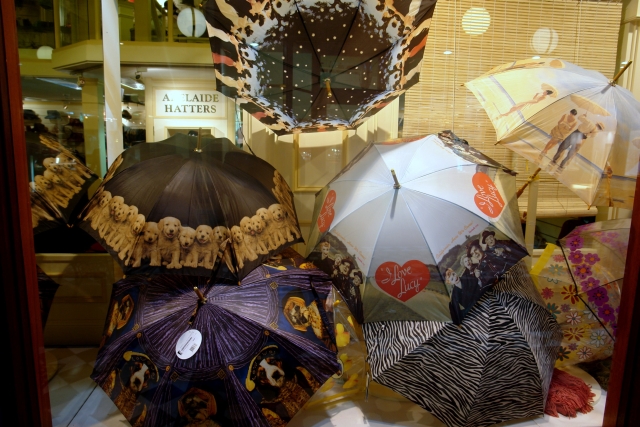
Gary Sauer -Thompson, Umbrella's, Adelaide Arcade, 2007
I don't pretend that this is autonomous modernist art that stands in opposition to the cultural industry. It offers up a new way of working to that of publishing in a book or exhibiting in an art gallery.
As I walked into the cafe I kept on thinking of Walter Benjamin, his Arcades Project and being a flâneur in a provincial city in the 21st century. I recalled this passage:
The street becomes a dwelling for the flâneur; he is as much at home among the facades of houses as a citizen is in his four walls. To him the shiny, enameled signs of businesses are at least as good a wall ornament as an oil painting is to the bourgeois in his salon. The walls are the desk against which he presses his notebooks; news-stands are his libraries and the terraces of cafés are the balconies from which he looks down on his household after his work is done.
The street would include festivals as well as arcades. Benjamin expressed himself in a literary form whilst Eugene Atget's experience of the street was expressed in a visual form.
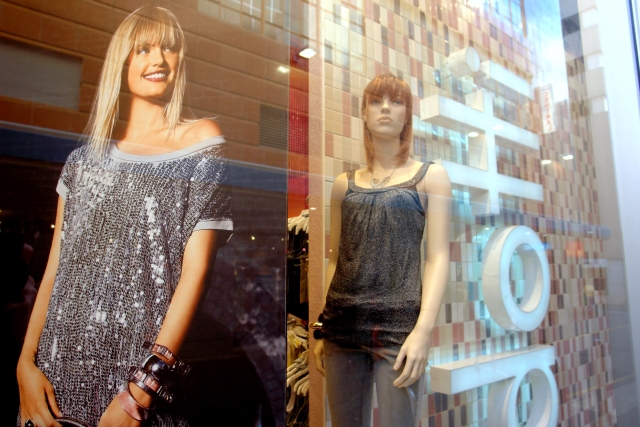
Gary Sauer-Thompson, David Jones models, Adelaide, 2007
As a street photographer, who is a flâneur leisurely exploring city streets where inhabitants of different classes mix, I' m experiencing a provincial city beginning to come to grips with a global economic world and its digital highways. Though this is a not city that is a great concrete jungle---barbaric and wild, reverting to a state of savagery, for such an observer-participant it is full of surprises and distractions.
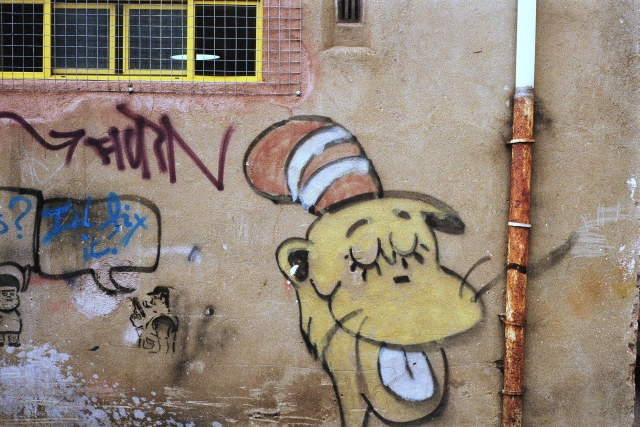
Gary Sauer-Thompson, rusty pipe, Adelaide, 2007
The literature of modernity, describing the fleeting, anonymous, ephemeral encounters of life in the metropolis, mainly accounts for the experiences of men. It ignores the concomitant separation of public and private spheres from the mid-nineteenth century, and the increasing segregation of the sexes around that separation. The influential writings of Baudelaire, Simmel, Benjamin and, more recently, Richard Sennett and Marshall Berman, by equating the modern with the public, thus fail to describe women's experience of modernity. The central figure of the flâneur in the literature of modernity can only be male. This has changed in postmoderbity.
|


A little quoted passage from Benjamin's Arcades Project:
For the flâneur, a transformation takes place with respect to the street: it leads him through a vanished time. He strolls down the street; for him every street is precipitous. It leads downward--if not to the mythical Mothers, then into a past that can be all the more profound because it is not his own, not private. Nevertheless, it always remains the past of a youth. (AP, 879-880)