|
August 12, 2007
In her Chic Theory article in the Australian Humanities Review Joanne Finklestein explores the idea that when we encounter one another in the anonymous sphere of the public domain, our clothes become garrulous and disclose desires, beliefs, even secrets. It makes sense to her to use appearances to mark culture, gender, class, religion, sexual proclivities.
She says that if mapping personal identity and values onto physical appearances in this unmediated manner seems simplistic, it is a widespread cultural practice.
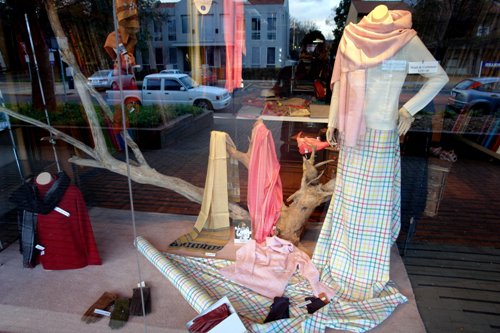
Gary Sauer-Thompson, Kingston, Canberra, 2007
It's less personal identity and values and more cultural identity and values---as in this look in this shop window is middle class and conservative. These are codes of taste, social location, and subjectivity of social identity.
Is it as Simmel, suggested, that we can interpret appearances and specifically fashion as a means of protecting individuals from a sense of being ground-down, levelled out and overwhelmed by the overarching socio-technological mechanism that is the metropolis.
We do have the transformative properties of fashion. Urban fashion provides a means of acquiring multiple lives, which works best in a social climate saturated with commodities, each of which is infused with promises of new sensations and new opportunities.
In Canberra we have stylish imagery in shop windows in upmarket Manuka coupled with the crass vulgarity of the public sphere that we move though to access the chic look.

Gary Sauer-Thompson, Manuka Court, Canberra, 2007
What we have is a smart shopping centre with its clothes shops, book shops, restaurants and public squalor in the piazza's that are not designed as squares for people intermingling with on another and meeting friends. There is little sense of being ground-down, levelled out and overwhelmed by the metropolis here.
But then Canberra is not a metropolis is it. Take away the overlay of federal Parliament and we are left with a country town, albeit a very affluent one.
|


