|
August 09, 2007
This graffiti image is just down the road from where I live in Sturt Street in the south west of the CBD of Adelaide. It's down a little lane consisting of a bunch of warehouses, car repair shops, and boarded up buildings. They will eventually be replaced by townhouses for young professionals and retirees.
This is an area in the process of redevelopment, in which the old trades give way way to the new service industries: lawyers, accountants, graphic design, financial companies.

Gary Sauer-Thompson, Graffiti, Adelaide CBD, 2007
Cultural conservatives would argue that I'm wasting my time taking photos of graffiti and interpreting them. This implies that I've embraced postmodernism wherein all texts or images are equally worthy of study, whether they are Patrick White novels or bus tickets, Heidelberg School paintings, advertising or graffiti. Such texts or images, these conservatives argue, are no longer evaluated for their moral or aesthetic value, but for their politics or ideology.
An editorial in todays Australian newspaper states this position in relation to literature:
Texts are no longer studied to reveal their moral or aesthetic value, they are "unpacked" or "decoded" to expose perceived racism, sexism and the exploitation of "victims" by the hegemonic classes. This ideological approach means that even if students do study anything from the canon of great literature it is through the jaundiced eye of left-wing politics, turning a deaf ear to the musicality of language or the aesthetics of beauty. It is extraordinary that at a time when young people feel more freedom to express open pride in their Australian identity they are not being exposed to what our greatest writers and poets have to say about being Australian.
Why should we evaluate images in terms of an aesthetics of beauty? Why not the ugly? Works by Goya are not beautiful. Or the sublime--the horrors at the heart of things? So why beauty, rather than the ugly or the sublime, then? Why concentrate just on high art paintings in our art galleries when we are surrounded by images (eg., advertising and graffiti) in our daily lives and need to learn how to critically read them?
The Australian's response is not persuasive. All that it says is that students have a right to see Australia through the eyes of our greatest painters, poets and (presumably, artists.) This is a defence of high culture in opposition to mass or popular culture, with the latter being rejected as kitsch, junk or trash.Yet it is the latter contemporary images that speak to me today about living in Australia than this kind of picture:
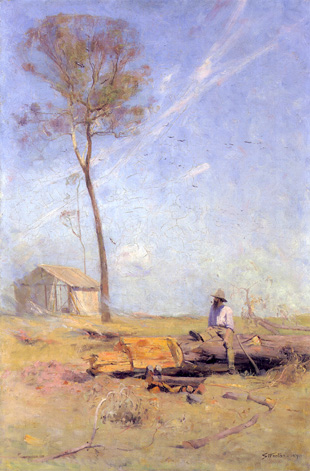
Arthur Streeton, Selectors Hut: Whelan on the Log, 1890, oil on canvas
That's colonial Australia of the past --before it became a nation. It refers to an Australia of a hundred years ago, not the urban Australia today that is plugged into the global world with its culture formed by global advertising.
|


Dead on arrival by this right handed educated female proves that street grafitti is not owned by one socio economic group.