|
August 30, 2007
Introducing his pathbreaking work The Production of Space (1991), Henri Lefebvre explains that:
...instead of emphasizing the rigorously formal aspect of codes [of representation], I shall instead be putting the stress on their dialectical character. Codes will be seen as part of a practical relationship, as part of an interaction between 'subjects' and their space and surroundings
Can we thinks of the social and cultural effects of advertising, with their spectacular distortions, in terms of a reckoning of how these distortions perform in terms of the Freudian logic of the dream?
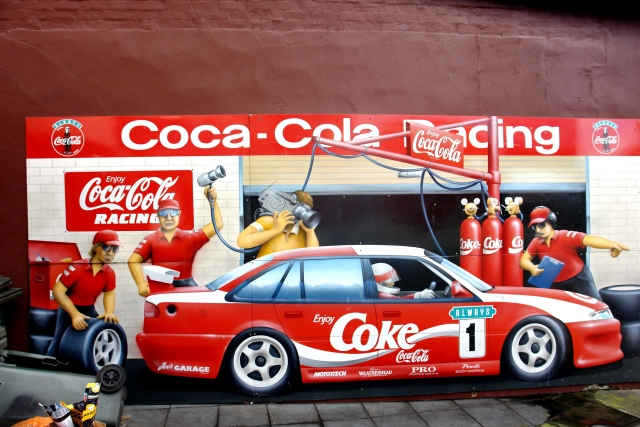
Gary Sauer-Thompson, mural Hobart CBD , 2007
Cars, coke and racing speak to petrol heads and their dreams of driving fast and desire for freedom from all social constraint. It is a mythic dreamscape constructed by global advertisers.
Secondly, the pre-eminence of vision is intimately related to speed in modernity,Travel through landscapes at increasing velocities in self-contained vehicles generates a fundamental disjuncture between travellers and the world outside, elevating the visual faculty as the pre eminent and architectonic sense through which one experiences space. This is best represented in the onboard cameras on the Formula I cars during a grand Prix race.
Update: 31 August
The film that keeps coming back to me on this visuality/travel issue nexus is Dziga Vertov's Man With a Movie Camera (1929), which uses radical editing techniques and cinematic pyrotechnics to portray a typical day in Moscow from dawn to dusk. Vertov isn't just recording reality, he transforms it through the power of the camera's "kino-glaz" (cinema eye). Vertov uses kino-eye to transcend the very reality he celebrates. In a 1923 manifesto, Vertov wrote:
I am kino-eye, I am builder..in bringing together shots of walls and details I have managed to arrange them in an order that is pleasing...I am kino-eye, I am mechanical eye, I, a machine, show you the world as only I can see it.. My path leads to the creation of a fresh perception of the world I decipher in a new way a world unknown to you.
If the Kino-eye (or camera-eye) is a cyborg combination of the mechanical movie camera and the human eye, then it offers new visual perspectiveand modes of perception; one akin to that of the flaneur strolling the urban streets of modernity.Visual impressions of the phenomeon of the streets flow past. Vertov juxtaposes images of everyday events, with the only suggestion of a narrative in Man with a Movie Camera is that Vertov is tracing a city from dawn till dusk.
|


Or taking photos without getting out of the car when on holidays. I read ages ago that the first thing people do when getting out of the bus at Uluru is take a photo. I have noticed recently that my wife is more likely to take photos in the car through the window while we are travelling. This is partly because there is no place to stop on a freeway/autobahn etc.