|
September 21, 2007
Late Sunday afternoon I meandered from the Exhibition Centre to the Grand Hotel of Marvellous Melbourne and explored around the Spencer St/ Flinders Street corner. This part of the Melbourne CBD was noisy, dirty and very unfriendly to pedestrians. I just wanted to flee from the dirt, noise and fumes.
I found a bit of wasteland between traffic lanes flowing to and from the corner:
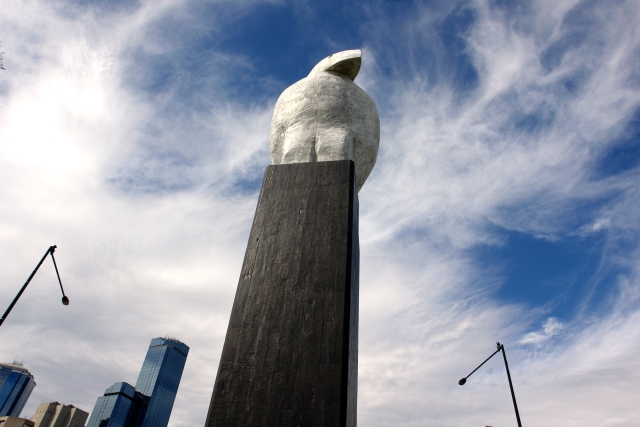
Gary Sauer-Thompson, statute, Melbourne, 2007
Since the Docklands looked to be an urban wasteland for a photographic flaneur I walked to the CBD. It was pleasant to wander down Swanston Street as the cars had gone. It was mostly trams and service vehicles. Suddenly it was enjoyable walking in the CBD looking at what was happening without having to fight against the noise and the smell of the cars. It's a definite improvement and Adelaide should do the same with King William Street in its CBD.
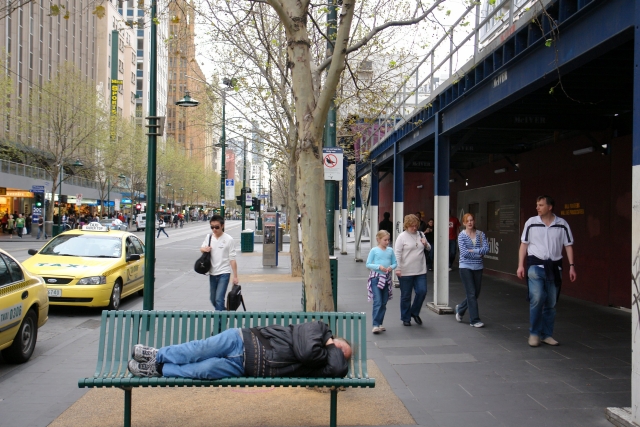
Gary Sauer-Thompson, Swanston Street, Melbourne, 2007
I remember Swanston Street as the grottiest retail strip in the city, the windblown City Square, the desolate, the demolished Queen Victoria hospital site, the rundown State Library forecourt, the l $2 shops and fast food and sex shops, lots of people shouting from doorways. In the 1980s, the city was little more than a daytime destination for commuting office workers who could not get home quickly enough. “Terminal decline” and “doughnut city” were how many commentators described the future of the CBD.
Now Swanton Street one of the more people friendly streets in the city, and it's pleasant to walk down it. Its part of the revitalization of the city as a centre of culture and entertainment.
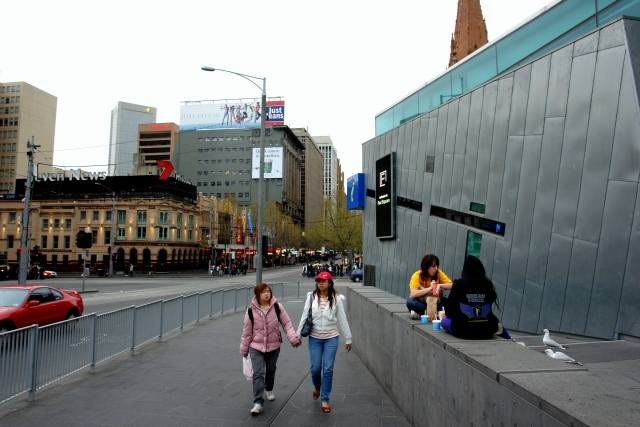
Gary Sauer-Thompson, Couple, Swanston Street, Melbourne, 2007
The Melbourne City Council deserves to be applauded for planning to revitalise Swanston Street through making it a semi-closed walk in the 1990s. I recall that everyone from the little tourist shops to big department stores like Myer opposed the development.
|


Gary
here is an interview with Jan Gehl, author of Place for People, in Metropolis magazine on how public spaces work. He talks about the idea of "city culture"--the way people think about cities and conceive them--can be developed.
I understand that Jan Geyl did a report for Adelaide. Was he a thinker in residence at one stage? What happened to his Report?