|
October 31, 2007
This post builds on Cam's earlier post here on the declining lakes levels in south-western America in a warming world.
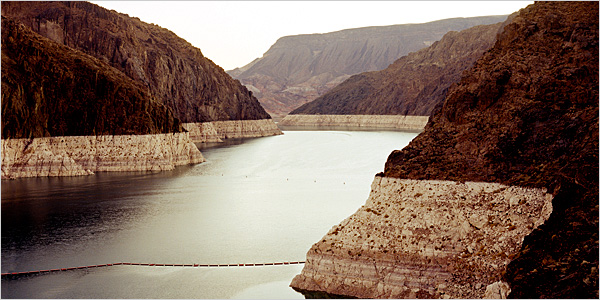
Lake Mead, in Arizona and Nevada, half-empty
This lake sits behind the Hoover Dam on the Colorado River, which currently provides water for some 30 million people in seven states--Colorado, Utah, Wyoming, New Mexico, Arizona, Nevada and California---and supplies nearly all the water for Las Vegas. The situation is one of limited Colorado River water supplies, increasing demands, warmer temperatures and the prospect of recurrent droughts.
It sounds familiar does it not?
Like the Murray-Darling Basin in Australia, the American West's huge economy and political power has derived from , and depends on, the 20th-century water infrastructure that conquered rivers like the Colorado, established a reliable water supply, and make deserts bloom. If you read the history of the south west of in terms of water development, then this account in the New York Times Magazine describes the current situation:
In the 20th century... all of our great dams and reservoirs were built — “heroic man-over-nature” achievements, in Binney’s words, that control floods, store water for droughts, generate vast amounts of hydroelectric power and enable agriculture to flourish in a region where the low annual rainfall otherwise makes it difficult. And in constructing projects like the Glen Canyon Dam — which backs up water to create Lake Powell, the vast reservoir in Arizona and Utah that feeds Lake Mead — the builders went beyond the needs of the moment. “They gave us about 40 to 50 years of excess capacity,” Binney says. “Now we’ve gotten to the end of that era.” At this point, every available gallon of the Colorado River has been appropriated by farmers, industries and municipalities. And yet, he pointed out, the region’s population is expected to keep booming.
Because the supply of water in the West can’t really change, and there's no no magical locked box of water, so the water is going to have to come from an existing use.
The situation is that of the Murray-Darling Basin. You can’t call it a drought anymore because it’s going over to a drier climate.
|


Gary,
An interesting section from Gertner's 'The Future is Drying Up' article in the New York Times Magazine that you linked to in the post.
Gertner says that evening, Binney and I had dinner together at a steakhouse in an Aurora shopping mall. When he remarked that we may have exceeded what he calls the “carrying capacity” of the West, I asked him whether our desert civilizations could last. Binney seemed dubious.
It describes the Murray-Darling Basin doesn't it.