Thought-Factory.net Philosophical Conversations Public Opinion philosophy.com Junk for code

Mandy Martin, Puritjarra 2, 2005. For further information on MANDY MARTIN, refer here: http://www.mandy-martin.com/
If there are diverse kinds of knowledge and ways of knowing place, then we need to learn to value the different ways each of us sees a single place that is significant, but differently so, for each perspective.
RECENT ENTRIES
SEARCH
ARCHIVES
Library
Thinkers/Critics/etc
WEBLOGS
Australian Weblogs
Critical commentary
Visual blogs
CULTURE
ART
PHOTOGRAPHY
DESIGN/STREET ART
ARCHITECTURE/CITY
Film
MUSIC
Sexuality
FOOD & WiNE
Other
www.thought-factory.net
looking for something firm in a world of chaotic flux

Franz Kline « Previous | |Next »
November 28, 2007

It still resonates, doesn't it, 50 years latter.
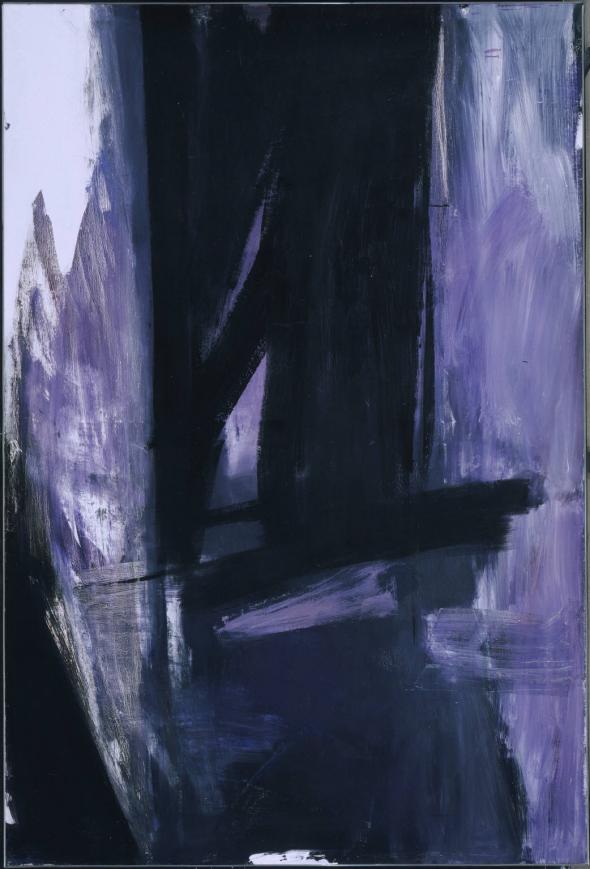
KlineFtorch.jpg
Franz Kline, Torches Mauve, 1960, Oil on canvas

Kline's work still has a dynamic, spontaneous and dramatic impact. We are confronted with starkly simple contrast of mostly abstract black-and-white planes and strokes. The wild beauty of the raw, coarse, elemental, and brutal splinters and vectors distinguishes Kline's pictures.

This abstract expresionist mood expressed itself in an aesthetic of crudeness. This aesthetic embraced the gritty, the rough, and the raw, and sometimes incorporated downright ugliness (e.g., the arts of graffiti and vulgar junk of the city etc)--hence the phrase "tangled shards of debris".

| Posted by Gary Sauer-Thompson at 08:24 PM | | Comments (2)
Comments

Comments

Gary
the traditional understanding of abstraction expressionism of the New York School was the rejection of both social realism and geometric abstraction, two dominant strains in American art in the 1930s, and by their interest in aspects of European-based Cubism and Surrealism. For them, art was no longer about copying forms in nature but was the expression of intangible ideas and experiences.

For some artists, such as Jackson Pollock, Willem de Kooning, and Franz Kline, the subject of art was autobiographical and emerged from the sheer act of making a painting. For others, among them Barnett Newman and Clyfford Still, the motivation was a search for the sublime. Yet for all, as Mark Rothko eloquently postulated, "art was not about an experience, but was itself the experience."

Pam,
We do need to reexamine the work of the relatively underrated New York artist Franz Kline, who was held to be a cut below the best. Kline's work has come to represent to the world at large mature Abstract Expressionism of painterly motion and even action painting.

The "tradition of the new," was similar to any other traditional artist.Kline, like de Kooning, planned, used drawings, refined, and reflected carefully and deliberately in his paintings of movement, fracture, and flow.

 
Post a comment

(If you haven't left a comment here before, you may need to be approved by the site owner before your comment will appear. Until then, it won't appear on the entry. Thanks for waiting.)

Name:
Email Address:
URL:
Remember personal info?
Comments: (you may use HTML tags for style)