|
October 08, 2003
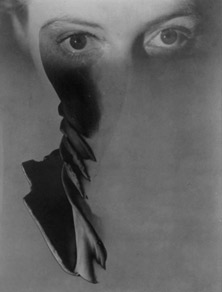 I've just noticed. There is an exhibition on surrealism at the Art Gallery of South Australia. I've just noticed. There is an exhibition on surrealism at the Art Gallery of South Australia.
It is fairly extensive with films and lectures on European surrealism.
I've missed the lot.
I only came across the exhibition today courtesy of the ever delightful and interesting DogfightAtBankstown.
The image on the left is Max Dupain, Surreal Face of a Woman, 1938
The educational material in the exhibition doesn't tell us all that much about the homegrown surrealist movement in Australia, or its significance. Art history rarely does. It's pretty much a mixture of biography, influence and formal analysis.
My understanding is that surrealism in Australia was understood to be a means of reuniting the conscious and unconscious realms of experience so that the world of dream and fantasy would be joined to the everyday rational world.
The surrealists understood the unconscious to be the wellspring of the imagination and poets and painters could tap into this normally untapped realm. Thus J. Gleeson, Composition, 1938, on the lower right
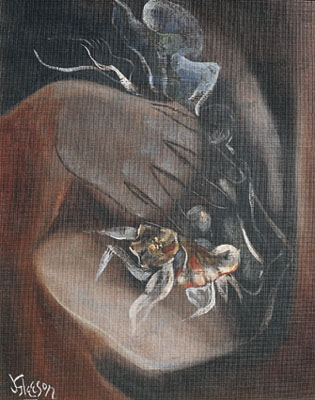 Gleeson became the most well-known of the Australian surrealist visual artists and he continued to explore the world of dreams. Gleeson became the most well-known of the Australian surrealist visual artists and he continued to explore the world of dreams.
Do we have a vindication of the role of the artist as a critic of society?
Though Gleeson expresses a faith in the subconscious processes of artistic production, it is not clear that this form of Australian surrealism ever broke away from the old idea of aestheticism (art for its own sake), or art being primarily about beauty.
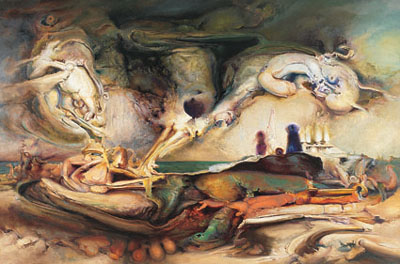
J Gleeson, Evening Ceremonies, 1986
Was there a critical edge to surrealism as a modernist avant garde movenment in Australia?
Or was it about finding the forms to express a new romantic national mythology?
Did it have anything to say that was otherwise to the Enlightenment rationality that had decayed into development, economic growth and raising standards of living in the new suburbs?
Does it say anything about the monstrous horrors of modern civilization? Were there monstrous horrors in the establishment of a liberal civilization on the Australian continent?
Did the moment of surrealism help us to understand our history?
If there was a critical edge then it was due to the effect of the crisis of the Depression and the barbarism of World War II:
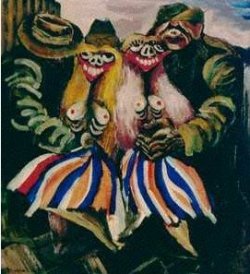 Victory Girls by Albert Tucker is part of the series called Images of Modern Evil. Victory Girls by Albert Tucker is part of the series called Images of Modern Evil.
It is an expression of shock and moral outrage at the decay or collapse of [Christian?] moral codes in wartime Melbourne. It sounds as if there was a rebellion against the repressive puritan moral code of the 1930s and the privations of the war (a decade of bleak times) in the name of individual freedom.
Tucker's images of evil series expressed his outrage and disgust at the living for the moment and women selling sexual favours for silk stockings, chocolates and money during WW2. The life of "the mass" in a modern city is reduced the underside of the city--criminals, prostitutes, clowns and psychotics. This urban life in the wartime city of Melbourne becomes an allegory of evil.
However, surrealism never really caught on amongst the visual arts in Australia. The art history books tell us that it was primarily continued by James Gleeson, who continued painting until the 1980s.
So this work by T. Gengenbach,The First Days of Spring at the Strait of Hormusz, (1980)
 comes as a suprise. It indicates that surrealism was, and has been, far more widespread and deeper than the Australian art history books have told us. comes as a suprise. It indicates that surrealism was, and has been, far more widespread and deeper than the Australian art history books have told us.
The history of surrealism in Australia yet to be written. It did not die out in the 1940s, squeezed by social realism and abstract expressionism. It continued on as part of the underground.
The art history books, (eg., Bernard Smith's Australian Painting) rarely make a connection is ever made to European surrealism other than the obligatory reference to Salvador Dali. Art lives in a self-enclosed world of its own.
So why is there no mention made of Andre Breton? Or Georges Bataille? Did the writings of these European thinkers resonate in Australia? If so in what way?
Did the conflicts and fallout between them have an impact in Australia? Did we have two kinds of surrealism in Australia? One about beauty and one about filth?
I do not know the answers to these questions. I wish I did. It seems as if we need to recover a history that has been lost.
What I do know is that the art history books are silent. Smith's academic/scholarly tome does not even mention Breton or Bataille in the index.
next
|


wow man, u r great.