Thought-Factory.net Philosophical Conversations Public Opinion philosophy.com Junk for code

Mandy Martin, Puritjarra 2, 2005. For further information on MANDY MARTIN, refer here: http://www.mandy-martin.com/
If there are diverse kinds of knowledge and ways of knowing place, then we need to learn to value the different ways each of us sees a single place that is significant, but differently so, for each perspective.
RECENT ENTRIES
SEARCH
ARCHIVES
Library
Thinkers/Critics/etc
WEBLOGS
Australian Weblogs
Critical commentary
Visual blogs
CULTURE
ART
PHOTOGRAPHY
DESIGN/STREET ART
ARCHITECTURE/CITY
Film
MUSIC
Sexuality
FOOD & WiNE
Other
www.thought-factory.net
looking for something firm in a world of chaotic flux

The tabloid gaze in politics « Previous | |Next »
September 19, 2005

The image below is how Mark Latham, a former leader of the federal parliamentary ALP and so Labor's alternative prime minister, is now portrayed in the media, after extracts of his diaries were made public on the weekend.
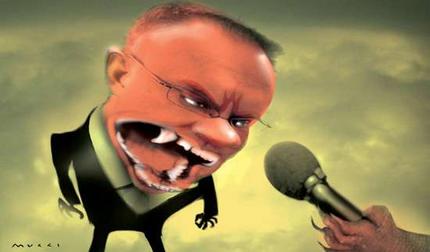
CartoonMucci.jpg
Michael Mucci

The Latham Diaries, which describe a toxic political culture inside the ALP, went on sale today. They are represented as the work of an aggressive and paranoic ego that seeks domination.

The older image of the mongrel streak of a political head-kicker from the Sydney suburbs has gone. Latham is not just seen as being out to settle old political scores. He has now become the mad dog full of poisonous bile who will infect people with his vitriol and cause great damage. He must be put down.

This demonisaton of a political figure shows the extent to which a tabloid media culture has penetrated our political culture. It has become tabloid in that it works in terms of crude, highly charged images. The visual and the rhetorical have fused.

At a more sophisticated level Mark Latham is described as having a narcissistic personality disorder. Latham exhibits all the classic signs of clinical narcissism, a condition 'marked by a hard-wired lack of empathy for other points of view and inability to see the world beyond the filter of self-reference.'

What is being dismissed by this kind of visual rhetoric is Latham's arguments about the endemic sickness, poison and backstabbing in our political culture, and the way the media works in collusion with politicians.

What is interesting in the reponse to the Lathman Diaries is the way that reality has become the image. The image has been become adrft from its referent--the real Mark Lathm as an homedadcarign for hsi two boys who wrote an account of his time in politics.

This tabloid image is not a distorting mirror as many claim. We stare in fascination at the circulating images of Latham as we become aware that they reflect nothing outside them.

| Posted by Gary Sauer-Thompson at 05:06 PM | | Comments (4) | TrackBacks (2)
TrackBack

Listed below are links to weblogs that reference The tabloid gaze in politics:

» media and democracy from Public Opinion
I interpret this image by Cathy Wilcox as an interesting attempt to connect the public image of Mark Latham the politician to the person:--a homedad in a Sydney suburb who is doing a bit of writing that reflects on his experiences as leader of the fede... [Read More]

» politics and ethical modernity from philosophical conversations
Some of the recent events in Australian politics highlight the hollowing out of ethical modernity that we have been exploring with Adorno.... [Read More]

 
Comments

Comments

But how much is the media a reflection of its audience. Judging by the Auian blogosphere, the labor supporters are just as keen to discuss it as the liberal supporters. All the big sites are agog with discussion and posts on it.

Could it not be argued, that the media is giving its audience what it wants?

Judging by the Au blogosphere, the audience wants reactionary celebrity politics....

Cameron
I have a problem with your use of 'reflection'.

The media are players who create situations, audiences and the meanings that make sense of particular events.

A very powerful visual rhetorical regime has been produced in Australia since the weekend--Latham as the mad dog---which is quite at a odds with the Andrew Denton interview on Enough Rope or the Tony Jones interviews on Lateline.

It has been created by the senior figures in the federal ALP and the corporate media establishment.

Gary, I disagree that they create situations to make sense of particular events. The media mirrors the prejudices of its audience. By prejudice, I dont mean racist or whatever, I mean the psychological demands of its audience. Consumerism can be therapy, and mass media provides a mixture of fear, reinforcement and therapy. Which is designed to keep the consumer buying their goods.

Fox would not exist in the US if there wasnt a market for it. Nor if there was no audience that wants the view of the world reinforced through an echo-chamber. The mass media, even segmented media, only reinforces what people want to have reinforced.

Bush currently has very low ratings. I am certain that the media polls as much as politicians do, to get the popular sentiment of the time. Bush is going to get his head kicked by the US media. Bill Maher asked if America was getting its media back. He is wrong to ask that.

The media will reinforce what the mass market wants reinforced, and at the moment, Americans think Bush is incompetent and incapable. Surprise, Surprise, an op-ed appears in the Washington Post (from an Iraq war supporter no less) with the title, "Incompetence not Racism". Talk about writing for your audience.

This Latham thing - I got the feeling there was a bit of an "oops" moment in Australia when Howard got the Senate. Giving absolute power of parliament to a government is not a good thing, most Australians know that. However, I would not be surprised if there is a narrative or a sentiment in the mass population to have this "oops" choice vindicated. An irrational Mark Latham, the attack dog meme, vindicates it.

There is a sigh of relief as people swarm to mass media in the same way people do to Fox, to have their world view reinforced, their mistakes excused - in the media.

John Sundman wrote;

As a final note I'll mention that one of my gay neighbors is a TV news producer for one of the big networks in Boston. On a few occasions I've teased him about his role in dumbing down political discourse in America, about the role that corporate news plays in distracting people from real issues with happy news, clebrity gossip, fake scandals and jingoistic blather. Not to mention a platform for reactionary homophobic ravings.

"John, John," he says. "What an idealist you are! Television news isn't about news! It's about product placement. If you want news, by all means listen to NPR. Or better yet, use the internet. The last place in the world that you should get news is from television."

And this from a television news producer for one of the most respected local stations in the country.

Interestingly, I wrote on that at hulver, and one of the sub-headings in the entry is, "Political Theatre", which is similar to some of your posts on your philosophy site about Arendt calling politics theatre.

Cameron,
It's late and so I have time to only respond lightly and briefly.

You raise a lot of good points. The Sydney Daily Telegraph and the Herald Sun are what I mean by tabloid media.

Piers Akerman of the Sydney Daily Telegraph and the Herald Sun's Andrew Bolt of the Herald Sun were both accused by Latham of being on a drip-feed from the offices of John Howard and other ministers; as is Alan Jones of 2GB. Latham also alleged that Alan Jones was being fed questions straight from Liberal headquarters.

I concur with this account.

In your first post your wrote that 'the audience wants reactionary celebrity politics'---the spectacle and mass deception.

I'm not so sure that is the case with Latham's extraordinary whistle-blowing effort. It shows otherwise.

It appears that citizens are reading the Latham Diaries to make up their own minds. They are not following the know-all reviewers who sledged the Latham text without reading the full version. Citizens are reading the text and listening to Latham's interviews.

So I don't see that the media mirrors the prejudices of its audience. The media is at odds with citizens in this instance. The more Latham talks the more he directs the focus onto the media to blow open the cosy Canberra club and the way it constructs politics.