Thought-Factory.net Philosophical Conversations Public Opinion philosophy.com Junk for code

Mandy Martin, Puritjarra 2, 2005. For further information on MANDY MARTIN, refer here: http://www.mandy-martin.com/
If there are diverse kinds of knowledge and ways of knowing place, then we need to learn to value the different ways each of us sees a single place that is significant, but differently so, for each perspective.
RECENT ENTRIES
SEARCH
ARCHIVES
Library
Thinkers/Critics/etc
WEBLOGS
Australian Weblogs
Critical commentary
Visual blogs
CULTURE
ART
PHOTOGRAPHY
DESIGN/STREET ART
ARCHITECTURE/CITY
Film
MUSIC
Sexuality
FOOD & WiNE
Other
www.thought-factory.net
looking for something firm in a world of chaotic flux

conservative Australia « Previous | |Next »
February 23, 2006

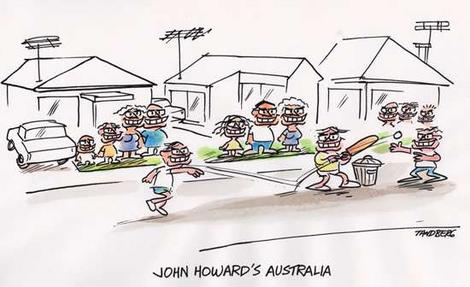
The white picket fence of suburbia in the 1950s has given way to the Mcmansion of today. Both stand for the utilitarian view that economic growth can, and should, be endless and bring ever increasing human happiness.
Tandberg3.jpg
Tandberg

The Australian evokes the conservative ideal of family, a home in the suburbs, the barbecue, and cricket in the back yard. This ideal, or myth, of ordinary lives and values is then counterposed to an inner-city enemy, (variously the culturally elite, the greeny Latte/Chardonnay crowd, or the chattering classes) who sneer at "ordinary" Australians and their ethical life.

The Australian is the paper that virtually created the caricature of the "Howard haters"--- those cultural relativist inner city types who dripp their resentment over their cafe lattes as they read the liberal Fairfax broadsheets.

Gee, how do they account for the rich young professional Liberals and Libertarians who drive fast cars, hang out in our inner city cafes and play with their Blackberries?

| Posted by Gary Sauer-Thompson at 07:03 AM | | Comments (7)
Comments

Comments

who drive fast cars, hang out in our inner city cafes and play with their Blackberries

hahaha

That is two out of three for me. I don't live in the inner-city though. When I did live in Sydney proper it was on the South Sydney beaches.

My broadband was recently taken out by a snowstorm. The funny thing was, I still had an internet connection. I keep dial-up for backup and have a data plan on my blackberry. That device matured once the worthless WAP technology was dumped and RIM added their blackberry internet browser which is HTML/Javascript enabled.

Basically the internet is ubiquitous now.

yeah I keep dialup as backup too, especially when I'm on the road. I pay $10 per month for the service.

Alas I do not have a fast car, nor am i likely to. But I live in an inner city apartment.

But I do have a PDA with wireless which I don't know how to use very well, and which I not yet configured so I can surf the net wiith wireless. Wireless is not very widespread in Australia, but that is beginning to change.

I inch into the world of the internet slowly, because it is so dam expensive to acquire and to run the technology.

Gary, The internet is pretty much my profession. I am a software developer who designs/develops web applications. I am pretty pragmatic about it. I don't choose cutting edge stuff for the sake of it. However, I work from home 3/4's of the time and travel the rest.

Wireless broadband was the only way I could break the cable monopoly (our community doesnt have DSL due to being too new!). It is pretty much essential for me to have a productive work environment as I am VPN'ed somewhere 95% of the time. The Blackberry is essential when I travel. It works out well.

Cameron,
I too work at home in (ie., Adelaide or Victor Harbor) when I'm not in Canberra or on the road. So it is also important for me to have an effective work environment.

I've mostly done that at home and Canberra.

I've not really set up well re travel, despite a portable computer and a PDA. I'm struggling with the lack of access to the internet in airports (Quantas Club is being used but it is mostly dialup) and hotels (they charge like wounded bulls for wireless or ADSL broadband).

So I've decided to use the PDA re wireless to surf the net. It is just not that widespread in Australia.

But I struggle with putting all this in place.

Gary, I hear you on the crap wireless support in hotels in Australia. I was at the Hilton in Brisbane's CBD getting charged $200 a night for a room - and the bastards stuck me another $40 for wireless broadband connectivity.

We had all sorts of problems getting wireless at Coffs Harbor and Tamworth too. It was a differentiator as to which hotel we stayed in, so hopefully it commoditises enough that it is chucked in for free with the room - like it is in the US.

Telstra, Telstra, Telstra. That thing needs to be split asunder so badly.

Yeah the Hilton is really expensive. They usually charge $25 per 24 hours for broadband.

I think that it is rip off, given the price of the rooms. It is standard in hotels in Australia.

I agree: it should be a service that is laid on with the room.

Sol Trujillo, the Telstra boss, is in Canberra today trying to convince them---Nationals, backbench Liberals, Ministers all in separate meetings to go light on the industry regulation or regulatory relief from the ACCC's rules on the prices paid by competitors for access to basic phone lines.

The meetings will be stormy. Canberra is angry, even when Telstra is talking in terms of a $20 billion expansion plan that involves building a new internet protocol core network, a new highspeed broadband network and a third generation mobile network. It's their big transformation strategy

Sometimes I reckon the board doesn't know what it is doing, or understands the new telecommunications environment. The stock is trading at near record lows, the company faces declining earnings, a savage cost cutting that is going on. And e they are talking about an internet movie download service when about 40 % of the population is unable to obtain highspeed broadband access.

Telstra's plans to build a new internet protocol core network as part of its $20 billion expansion plan. What does that mean?

Gary, Yeh monopolies are hostile to a systems philosophy. Especially legislated ones as they are hard to route around as damage. That is one of the reasons why I am for the deregulation of the spectrum - rather than auctioning it - so that small companies, communities or individuals can route around the damage of the monopolisation and high capitalisation of cable/copper.