|
March 24, 2007
I saw this excellent sculpture by Fiona Foley when I visited the postmodern National Museum of Australia:
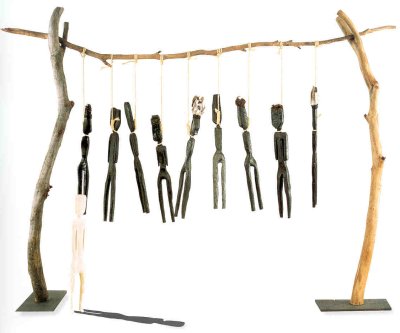
Fiona Foley, Annihilation of the Blacks, 1986
It is a response by Foley, an urban based Aboriginal artist, to her mother’s accounts of massacres of Aboriginal people in the Maryborough and Fraser Island areas during the second half of the 19th century. Specifically, it concerns the massacres on the Susan River, a tributary of the Mary River, the story of which was passed on as Badtjala oral history to Foley's mother as a child.
Foley, like other urban Aboriginal artists, has studied at European-style art schools is aware of current debates in art the workings of the art market, and the modernist discourse in the international art scene, surrounding notions of the 'primitive' and the 'other'. She was part of the movement that in the Australian art world that held art by Aboriginal artists could be part of the wider contemporary scene, and so could move away from art galleries specialising in indigenous art to more mainstream ones.
This challenges a dominant discourse in Australia that has promoted the perspective that ‘authentic’ Aboriginal culture is confined to the relatively undeveloped, under-populated, and isolated, north of the continent. Images of ‘tradition oriented’ Aboriginality have played a central role in the promotion of Australia as a distinctive tourist destination. This discourse consigns Aboriginal people to the past, but not to history’ whilst the term ‘traditional Aboriginal culture’, fixes all ‘authentic’ forms of Aboriginality within precolonial history and views all forms that diverge from this, and the people as a diminishing of traditional culture.
An alternative discourse makes Australia’s history of race relations visible in the culturall landscape, which makes the inclusion of Aboriginal perspectives in the official telling of Australian history highly contested.
|


Yes very thought provoking.
I especially like the white figure casting the black shadow.
It makes one think of the reverse too with white colonists hanging and a black man standing casting a white shadow.