Thought-Factory.net Philosophical Conversations Public Opinion philosophy.com Junk for code

Mandy Martin, Puritjarra 2, 2005. For further information on MANDY MARTIN, refer here: http://www.mandy-martin.com/
If there are diverse kinds of knowledge and ways of knowing place, then we need to learn to value the different ways each of us sees a single place that is significant, but differently so, for each perspective.
RECENT ENTRIES
SEARCH
ARCHIVES
Library
Thinkers/Critics/etc
WEBLOGS
Australian Weblogs
Critical commentary
Visual blogs
CULTURE
ART
PHOTOGRAPHY
DESIGN/STREET ART
ARCHITECTURE/CITY
Film
MUSIC
Sexuality
FOOD & WiNE
Other
www.thought-factory.net
looking for something firm in a world of chaotic flux

Australian identity « Previous | |Next »
April 27, 2007

I had posted on the conservative interpretation of Australian identity and Anzac Cove over at public opinion yesterday:
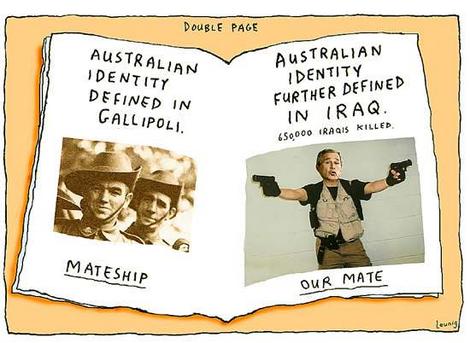
mateship.jpg
Leunig

Leunig is right. The conservative nationalist account of Australian identity is based on military values and fighting wars. It implies that all wars fought by Australia are good, and it is intolerant of dissent by citizens about that judgment. It is an account of national identity that tacitly denies a multicultural or even a liberal pluralist Australia, as it implies assimilation rather than a nation based on the rights of individuals to different cultural identity, ethnic recognition and respect.

Cultural conservatives--John Hirst, Janet Albrechtson, Piers Ackerman and Andrew Bolt---say that a distinct Australian national identity was forged at Anzac Cove in 1915. Therein lie the roots of Australian nationalism. Multiculturalism threatens this national identity because they assume that it necessarily denies the importance of Australian culture. Their mode of discourse works with a "horror" of the Other that remains other.

| Posted by Gary Sauer-Thompson at 07:11 AM | | Comments (4)
Comments

Comments

650,000....That would be like killing everybody in Tasmania and then some. Terrible!

Les,
the civilian toll is awful --it's the 2006 Lancet Report--- and hard to justify in the name of democracy and freedom. You can see why many Iraqi's have fled to Syria and beyond, and why many of the Iraq's who have remained want the US and UK out of Iraq.

I would flee in that situation. Contrary to the endless claims from the Bush administration and the Howard government and its followers -- the trend in Iraq during the occupation, continues to worsen significantly.

Ever since the "threat" rationale for the war vanished (ie., Saddam had WMDs which would be used against us), the principal, if not exclusive, "justification" for the war was that it would improve the situation of the Iraqi people.

Clearly, that has not happened. Nor is it likely to.

The Lancet figures are a concoction. Half a million died in the fire bombing campaign against Japan in WW2 which was more than died at Hiroshima and Nagasaki combined. Is Lancet seriously trying to suggest that more civilians have died in Iraq post 2003 than in those campaigns in an era of total war?

Colin,
The Lancet published two studies on the effect of the 2003 invasion of Iraq and subsequent occupation on Iraqi mortality, the first in 2004, the second (by many of the same authors) in 2006. The studies attempt to estimate the number of excess deaths caused by the occupation, both direct (combatants plus non-combatants) and indirect (due to increased lawlessness, degraded infrastructure, poor healthcare, etc.)I appreciate that the Lancet surveys are controversial because their figures are much higher than those in most other major reports

As I understand it epidemiologists in the field of conflict and public health supported the methodology and findings. This new study highlights a significant increase in civilian deaths since 2003.

The methodology used is consistent with survey methodology that has long been standard practice in estimating mortality in populations affected by war.

epidemiologists in the field of conflict and public health supported the methodology and findings. The methodology used is consistent with survey methodology that has long been standard practice in estimating mortality in populations affected by war.

 
Post a comment

(If you haven't left a comment here before, you may need to be approved by the site owner before your comment will appear. Until then, it won't appear on the entry. Thanks for waiting.)

Name:
Email Address:
URL:
Remember personal info?
Comments: (you may use HTML tags for style)