|
May 23, 2007
This is looking towards Flinders Chase National Park in the south west of Kangaroo Island. It is mid morning around 9.00am. This landscape is wild and rugged, and a far cry from the natural beauty folded within the petals of a rose. It is an ideal spot to be developed in terms of eco-tourism and the aesthetic appreciation of nature as nature for middle class international tourists.
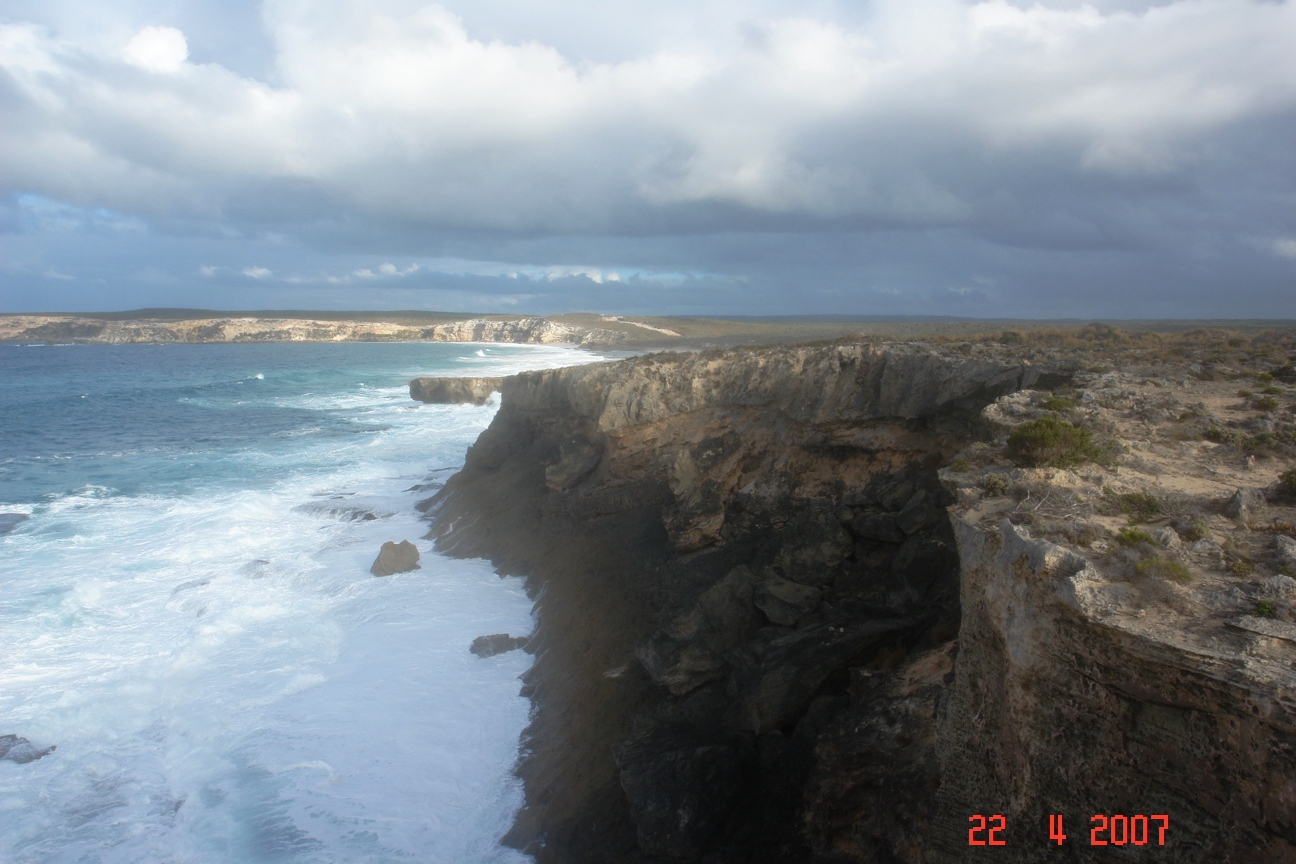
Gary Sauer-Thompson, sandstone cliffs, Hanson Bay, 2007
It is what aestheticians call an aesthetically pleasing natural object. Kant argued in Critique of Judgment that aesthetic judgment was different from cognition and morality, even if they are formally linked. I accept that knowledge can enhance our aesthetic appreciation of the sublime (eg., our recognizing how the various fauna and living species are ecologically and evolutionally interdependent). I also accept that aesthetic judgment is linked to ethics as we both desire and have ethical obligation to preserve wilderness because of its intrinsic value.
However, Kant went on to suggest that the natural thing recognized as natural---the above scene--- is beautiful in so far as it mimics art. Kant held that a things being natural is not sufficient for it to count as aesthetic. If it is to qualify as such, it must be recognized as nature and yet at the same time mimic art. By 'mimic' is meant something like nature is seen as if it were art; a framed picture as it were.
This is the tourist approach to natural vistas. The managers of tourism presuppose that natural vistas should be evaluated in terms of design features such as “form, contrast, distance, color, light and angle of view” ---as “scenic view”.This is cut out at various roadside lookouts and which form so much a part of the popular or common sense conception of natural appreciation. It is a classic example of projecting onto a natural setting such formalist values as balanced overall composition, dramatic focal point (embodied, say, in a centrally positioned waterfall or granite formation), and adequate distance separating viewer and scene (allowing the spectator to take in the entire prospect).
Kant's suggestion--- that nature is seen as if it were art --- is what I struggle with, and my reaction is to reject it, even though I appreciate that many go back to Kant because Hegel had placed natural beauty under a dark star. For Hegel beauty reflects intentional creation (or free choice for Schiller), not the incidental results of blind, natural forces. Benedetto Croce similarly states that the sense of natural beauty is a derivative of artistic beauty. Beauty of nature cannot be explained unless one regards it as the work of a divine creator. Beauty, according to Croce, is a synonym of intuition and expression, and these refer to the artistic form. The content of the work is beautiful only when wrought into form. Given the exclusive focus of twentieth-century philosophical aesthetics on art, we have the back to Kant movement.
I would argue that Hanson Bay's natural environment of sandstone cliffs is beautiful in itself; and not because it mimics a colonial landscape, or a reworking of the uninhabited panoramas of Salvator Rosa, whose wild (untamed) landscapes express the tendency towards the romantic and picturesque.
Some artists, such as Mandy Martin, judge what is important about the landscape as the spiritual recognition of place as expressed by Indigenous people. I was simply overawed by the power of the sea, wind and light in this space in the stormy morning when I was in this place.
So I would argue against Kant's idea that the aesthetic appreciation of nature involves seeing the latter as art. Rather we struggle to express the beauty or sublimity of the place by taking photographs by shaping the content into form. Secondly, if nature is not an human artefact, it cannot be judged by the criteria appropriate to the critique of artworks in galleries and museums. However, we do view natural environments from a humanly constructed framed viewpoint. An example of this is would be my viewing Hanson Bay through a cabin window: the environment acquires the appearance of balance and unity it would miss were it viewed either from outside the cabin or from a point inside the cabin where the window frame obstructs a view of the clouds and cliffs in the setting.
What this experience of Hanson Bay discloses is the need for an aesthetics of natural environments, or more particularly an environmental aesthetics.
|


