|
May 24, 2007
The National Gallery of Australia is a good modernist building that has a particular approach to the presentation of artworks within its concrete walls. Colin Madigan designed the Gallery as a brutalist, heroic fortress. Just like his High Court. That too stands in splendid isolation beside the lake.
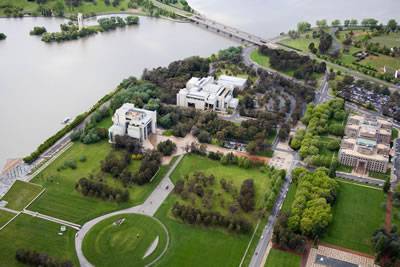
John Gollings, National Gallery + High Court, Canberra
This is the area I work and live when I'm in Canberra. I often walk around the edge the Lake from Kingston to Parkes and explore the sculpture gardens at the back of the National Gallery. I never enter through in the front door. The back end is softer than the front, as the building is partially obscured by the native trees. I often sit in the garden and wonder about Walter Burley Griffin's urban utopia, and how it is evolving.
The Gallery has a troubled history and is currently caught up in controvery that is ongoing.
The National Gallery, now a heritage-listed building, does have its problems as its history discloses the fraught relationship between 20th-century architecture, city design and museology. For one, it is not a good art gallery. Elizabeth Farrelly, in an op.ed in the Sydney Morning Herald highlights the key problem for museology. She says:
Brutalism, at its best, combined bold forms, high contrast and breathtaking subtlety; rhythmic, textural and assured. At worst, admittedly, it was just brutal... Can you hang art in spaces 15 metres high? Here, and perhaps only here, successive directors - James Mollison, Betty Churcher, Brian Kennedy, Radford - agree. No. Impossible. Even works as confronting as Jackson Pollock's Blue Poles or David Hockney's A Bigger Grand Canyon shrink and quake in such caverns.
Although the ideology of modernism says that the NGA is a neutral space —a space that defers to art instead of visually competing with it-- this is undercut by the canvernous spaces themselves. Space is more important than the art for high modernism. The architecture is about itself.
Farrelly highlights another problem--the linkages between the National Gallery, public space and the movement of people:
The national gallery, comparably handsome, has an undeniable orifice problem. And it's not like there's pedestrian flow to speak of. Out on the lakefront, only metres - worlds - away, walkers, cyclists and Korean weddings stream past. South, on the parkway, Canberra's thrusting metropolis roars on. But around the parliamentary triangle itself, which Burley Griffin would have crammed with bustle, you can walk half a day and not set eyes on another living soul. Here in their lonely lakeside paddock sit Madigan's two great, heroic fortresses, the gallery and the High Court. Gloriously disdainful, fabulously vast (yet dwarfed by the still vaster spaces around them) and radiantly alone, they are totem buildings in a token town. It's the great Australian metaphor; emptiness within emptiness within emptiness.
The phrase 'great Australian metaphor; emptiness within emptiness within emptiness' is a bit tired. The problem is what sort of national gallery should the National Gallery of Australia be? Should it seek to emulate the great national galleries of Europe and the Americas? Should it complement - the well-established state galleries? Should it serve both the Canberra region and the nation? Can it afford any longer to mount the blockbuster exhibitions of works lent from other countries that drew the crowds during the 80s and 90s?
Thirdly, what we have is a national gallery with a $3 billion collection in a building designed for 1000 works, when it now has 140,000 works.
I would have though that the gallery's first priority is Australian art then collecting the art of our neighbours in the Pacific Rim region. The Gallery just does not have the $20 million-plus it would cost to continue to buy works by a Kandinsky or a Mondrian, and there are limits to the blockbuster shows sourced from overseas.
|


I used to work at the Taxation Office in the mid 80s and almost every lunch hour I would walk to the ANG. It has many faults, for sure, but I loved the high ceilings and towering works of art. I would always catch the Gorky, Krassner, de Kooning and Miro. I never got sick of them.