|
August 21, 2014
The Coalition has changed its budget rhetoric.
It has dumped the budget crisis/ rhetoric and sovereign risk in favour of there is no need to worry as most of the appropriations bills have passed the Senate and that there is no problem if the Senate doesn't hurry up with the rest of the budget. The rest --Medicare co-payment, deregulation of universities, tough new arrangements for the unemployed etc--- amount to $25 billion.
The bullyboy tactics to impose austerity haven't worked. Australians haven't bought it, and they are skeptical of the government's selling of austerity and the need for a shift to a deregulated market. They see unfairness.
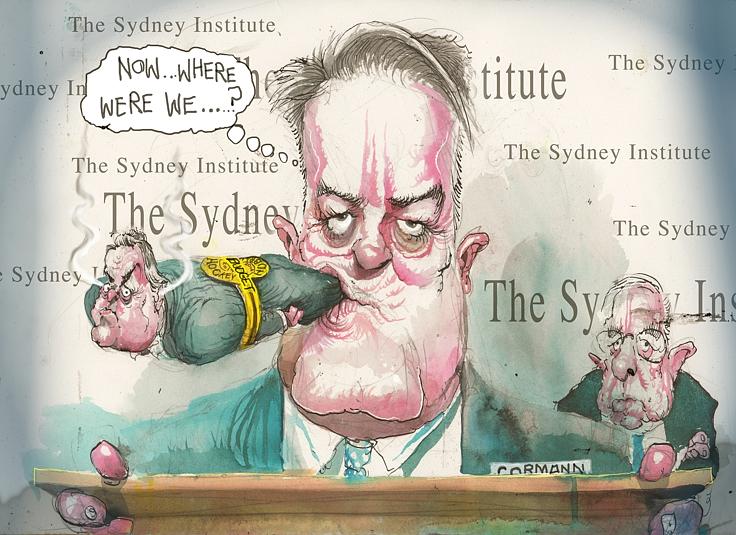 David Rowe
There is a medium term (a decade) for a consolidation of the budget, given the end of the mining boom and and the ageing population. There is a need for debate over how that consolidation will happen given the lower income growth than in the past decade.
Should the consolidation involve a shift towards small government, greater scope for the deregulated market and rolling back the welfare state? Or should it retain the targeted welfare state and end corporate welfare?
The Coalition's proposed deregulated university reforms mean that universities no longer function to ameliorate social status and inequality, but are part of a renewed capitalism; the private benefits of higher education to its graduate beneficiaries are today used to justify the removal of public funding and the charging of exorbitant fees. Capitalism’s logic is to widen inequality and, with the re-establishment of inequalities in wealth alongside inequalities in income.
The neo-liberal mode of governance---neo-liberalism is a political project at least as much as it is an economic theory ---means the privatisation of public services. It is ideologically associated with a classically minimal liberal state, with the efficiency of ‘free markets’ as against the ponderous and wasteful outcome of state planned economies and nationalised industries that characterised Keynesian welfare states. In practice neo-liberalism is linked with increasingly authoritarian uses of state power and with re-regulation of the economy to protect financial and mining capital rather than the de-regulation championed by advocates of neo-liberalism.
Increasingly, education is perceived as an object of private capital investment, both through outsourcing of functions to for-profit companies and the direct entry of for-profit providers. Universities are now knowledge corporations, competing in a global market for higher education.
|





The Coalition's charming of the Senate cross bench about passing its budget hasn't worked. So they have shifted back to going on the attack and making dire threats.
Christopher Pyne is now threatening to make cuts to research funding. Mathias Cormann is threatening future tax hikes as the only possible alternative should the Senate fail to pass the Coalition's spending cuts.
Hockey keeps on muttering about a “Queensland-style” austerity budget.