|
August 4, 2003
I've been meaning to mention this for some time. It is an article by Roger Kimball called Architecture & ideology published in THE NEW CRITERION.
The link is courtesy of David over at City Comforts. David runs a great weblog. Have a read of it sometime. I have to admit that I do not read, let alone browse The New Criterion. Though David says that it is an interesting and learned journal of a conservative bent I have been put off with cultural conservatism of defending an embattled culture based on universal values in a post modern or virtual age. It all smacks too much of T.S. Elliot for me with too many sneers and snide remarks about postmodernism.
Kimball's text is a talk opens an exhibition. The is an exhibition of the architecture and urban design of Leon Krier. Krier is seen as the father of the New Urbanism movement in America. He designed the English model town of Poundbury for the Prince of Wales. The other architect included in the exhibition is the postmodernist Peter Eisenman His is a negative architecture: one that is radical and critical in that it confronts our experience of alienation and fragmentation in late modernity on its own architectural terms.
So we have two quite different responses to architectural modernism, eg.,

(Seagram Building, Mies Van der Rohe)
I have a deep dislike of corporate modernist architecture: I found its corporate form anti-democratic and totalitarian. My philosophical sympathies lie with the neo-Nietzschean Eisenman, but my heart lies with the new urbanism. That movement is about reforming the design of the built environment, and raising our quality of life and standard of living by creating better places to live. It is concerned with the revival of our lost art of place-making through a re-ordering of our urban built environments so they are more sustainable and people friendly.
This then is an exhibition of polar opposites. So what does Kimball make of it?
Kimball says:
"...the subtitle of this symposium—“Two Ideologies”—may have a useful clue to at least part of the answer. It is, I think, a spectacularly apt subtitle. For with these two architects we really are dealing not simply with radically different approaches to architecture but with two opposing ideologies."
Kimball plays around with 'ideology' before settling on understanding it terms of the two architects making
"... efforts to recast architecture on the basis of a specialized program or agenda that takes its cue as much from extra-architectural considerations as from architectural ones."
That's understandable. If you are going to dig your way out of modernism, then you need to do more than talk about architectural form since modernsim was deeply interwined with social, economic, and political processes of contemporary life.
Eisenman represents deconstructivist architecture plays with form, he deconstructs function, he dislocates the way we live in space, he digs away at the metaphysics of architecture, or what architecture should be, so that the process of dislocation can allow new possibilities of occupiable form.
It looks like revivifed modernism to me---the pure pursuit of form:

Frank House
It is an autonomous architecture that is removed from reductive functionalism and the displacement of architecture from any sense of context:

Columbus Convention Centre
Kimball has less to say about Krier. This work is equally sweeping and explicitly anti-modernist. It appears to be a traditional urbanism:

Poundbury
It aims to avoid suburban sprawl to create a healthy urban life centred viable communities. Architecture help us find a place in the world, and in history too: ----Windsor Village Hall, Windsor, Florida:
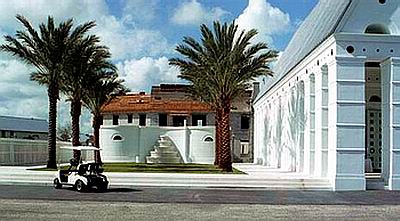
This urban design is based on local vernacular as the basic architecture. Rather than economics and industrial production dictating the form of the city; the cities' form, organic nature and moral order qualifies and shapes the forms and of production and of exchange. Architecture is bought back into the realm of dwelling.
Having outlined both sides of the opposition Kimball then tries to make sense of the opposition by giving it some sort of context. He says:
"I believe that if we are to get a fruitful perspective on the opposition named in the title “Eisenman/Krier: Two Ideologies,” we need to put that opposition in a wider context. One way of doing that allows me to introduce... the English architect and architectural historian Geoffrey Scott."
Why Scott? According to Kimball he makes the body the indispensable measure in architecture and enlists humanist values for architecture. Consequently, architecture can never be judged by aesthetic criteria (he means beauty) alone since space is shaped for people to live with and in.
And that's it. Apart from some admonitions. It ends all a bit flat really.
|


I am enjoying reading your writings about architecture. What about some of the things that have done in Australia with regard to sustainable housing? There is an eco-village at Willunga isn't there?