|
August 12, 2003
My reading of the fragments of Rick's project on Susan Sontag's Regarding the Pain of Others has hit a flat spot. I really struggled with my comments on Rick's twelve post. I wrestled with Sontag's claim that:
"Most depictions of tormented, mutilated bodies do arouse a prurient interest….All images that display the violation of an attractive body are, to a certain degree, pornographic.”
I felt a closure here and I tried to open it up. But I felt that I never got to prise it open.
I sort of played around with the images of S/M to loosen up the pornography bit. I opened up a cutting away the closure but I could not do anything with it. I needed to say that not all depictions of mutilated bodies lead to a prurient response and that not all displays of attractive bodies are pornographic to a certain degree. Hence the appeal to Mapplethorpe ---for the display of attractive bodies.
But I lost it. This inbetween post picks up the thread. Here is something to help turn the cutting into a pathway:
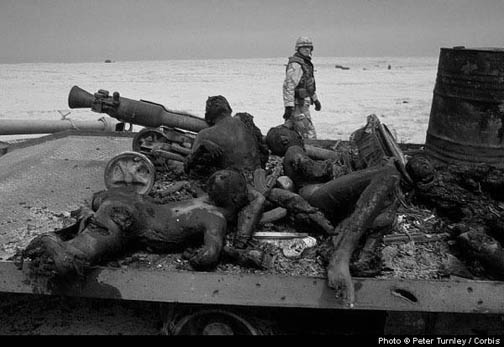
It is by Peter Turnley
That is mutilation----charred bodies. There is no sense of prurience. It is horror. That sort of photography (or graphic representation) is what Sontag closes off. So what happens if we follow this pathway?
Well we can reinforce that it is pathway by contrasting it with the following photograph of rape in war:
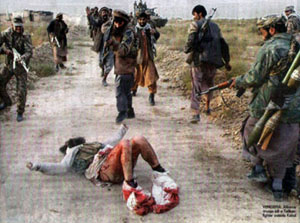
It's an execution by the Northern Alliance in Afghanistan.
That is an interpretation of what Sontag's could mean by her claim that "depictions of tormented, mutilated bodies do arouse a prurient interest." That image is shot from the viewpoint of the photographer embedded with the Northern Alliance. This is an illustration of the way the military uses rape as a weapon of war.
That reading can be reinforced when it is juxtaposed to this text:
"[Sergeant Bruce F. Anello] describes the grotesque pranks played upon corpses, the rapes, and the way platoons were 'willing to kill any body' simply in order to beat another platoon's 'kill record.'"
—from An Intimate History of Killing, p 205
Then, perchance, I happened to see a Robert Hughes doco on Goya, on ABC on Sunday night called Goya: Crazy Like a Genius. Boynton's comments on the early part of the doco and Hughes' sleazy remarks about Goya's nude (Naked Maja) can be found here.The doco had lots of very grim dark images:

Francisco Goya, From the Disasters of War
But there was little by way of sexual prurience or pornography being combined with horrific images on the doco. I guess Hughes would know if there were any. Or did he avoid combing the two? But Goya does seem to be another exception to Sontag's claim.
And it does depend on the sort of bodies we are talking about:

That is beautiful but it is not prurient.
So we have a pathway out of the Sontag closure. That's sufficient for now.
|


You are running into problems at the same point I did. I think her book is an 'open text' in the same way that Meyer Schapiro's essay, "The Nature of Abstract Art" is an open text: it is inconclusive. And, as Thomas Crow says in 'Modern Art in the Common Culture': "it is just this quality, its unresolved oscillation between negative and affirmative positions, that makes it so valuable." (p.18)
What you are experiencing, I believe, is the difficuly of this oscillation. The important point, it seems to me, is to stay in this oscillating space to feel all of its edges.
Others have criticized her for this oscillation and inconclusiveness. It may well be the book's strength and ultimate value. One remains haunted by it: which is, I believe, her main conclusion vis a vis the images she discusses: the work itself, in its style and oscillating argument is a reflection of this haunting quality.
rv