|
August 7, 2003
The twelve part of Rick's project on Susan Sontag's Regarding the Pain of Others links the mutilation of bodies to pornography. The Sontag text says:
"Most depictions of tormented, mutilated bodies do arouse a prurient interest. All images that display the violation of an attractive body are, to a certain degree, pornographic" -- (Sontag, p. 95)
The image that Rick juxtaposes to this text is Andrea Mantegna's St. Sebastian:
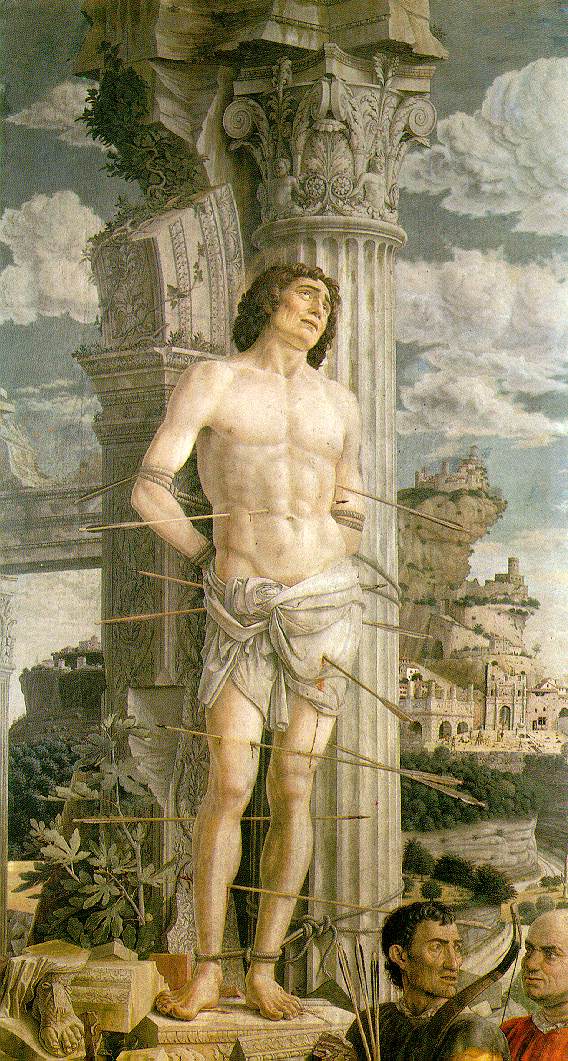
This is the biography of St Sebastian. He was a guardsman in the Roman army, a Christian martyr in the Rome of Diocletian, who survived, and then recovered from, being riddled with arrows. He was then stoned/clubbed to death on Diocletian, orders and his battered body was thrown into a sewer.
Rick asks whether this an example of an image that rouses a prurient interest in us and so is then partly pornographic. My first reaction is I don't know. My second response is that there is more going on here than depiction. We also have the process of reading and the interpretation of meaning.
St Sebastian is an image that is overlaid with a diversity of historical interpretation.
For instance, in the Renaissance image St Sebastian signified Christian courage. Yet he is in writhing in the ecstasy of the arrows that pierce his body. And he also represents Hellenic loveliness. St Sebastian has been contested through history. He becomes the patron-protector from disease. I
In our time--the twentieth century---St Sebastian's mutilated, attractive masculine body is given a gay reading that appropriates the image from the Catholics and then subverts it. The image is now interpreted as expressing homosexual desire, the isolationalism of the rejected homosexual and a prototypical portrait of tortured closet case: eg., this photograph by F. Holland Day
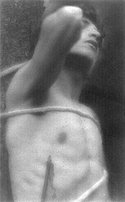
of trapped, doomed homosexual existence.
But there are other gay readings. St Sebastian has become a central but a central, albeit sadomasochistic, gay icon. This film by Derek Jarman is about faith, desire and power, raw lust and genuine love. Saint Sebastian has significance in this time of AIDS, due to his role as both an icon of tortured male beauty and as the patron saint of sufferers of the plague.
So it is about both the depiction and the interpretation of the image within a particular situation.
Let us come back to Sontag's ethical cultural criticism and her remarks that
"Most depictions of tormented, mutilated bodies do arouse a prurient interest. All images that display the violation of an attractive body are, to a certain degree, pornographic."
Sontag is saying that the representation of tormented mutilation of the attractive masculine body gives rise to a morbid fascination with sexuality, arouses lust or desire and gives rise to experiencing pleasure from pain. Well this response has be contextualised---and on way this can be done is with a Museum of Sex. (link courtesy of Michael over at Two Blowhards
My third response is that Sontag's cultural criticism is a particular and negative reading from a range of diverse, historical ones. Let us consider the pathway that takes us into pornographyby picking up on the trail that set in motion the culture wars of the 1990s in the US.
The contemporary example is the gay S/M world opened up by Robert Mapplethorpe's images of sado-masochism In 1990 Mapplethorpe's work in The Perfect Moment exhibition shown at the Contemporary Arts Center in Cincinnati, was seen as appealing to a prurient interest in sex and the images deemed offensive (ie., pornographic). The museum and its director, Dennis Barrie, were indicted for pandering to obscenity with respect to some of the gay sadomasochistic photos:
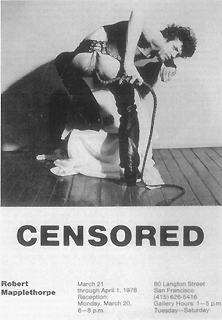
That is a tough and provocative image.
Now the ethics of this is not as cut and dried as that conservative reading makes out. That interpretation was contested. You can argue that Mapplethorpe's photography did recover gay sadomasochism from the sites of its subcultural practice, and bring it back to the avante-garde space of the alternative art gallery. Most of the images from Mapplethorpe's S/M project theatrically frame the modelling of the erotic costume and sadomasochistic equipment of the gay men. What is on display is an erotic theater whose players determine their own props and costumes, their own pleasures and script:

Mapplethorpe's critical image making shows that it is possible to avoid producing images of mutilated attractive bodies that arouse a prurient interest; and that it is possible to contest those images that display the violation of an attractive body as pornographic:
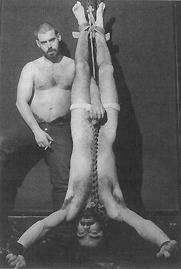
Mapplethorpe's S/M work is on the boundary between art and the pornographic. How do we negotiate the multilayers of this pushing the boundary and make them more fluid? How do we avoid tripping over and falling into the unethical?
Here is a suggestion. If the ethical in the aesthetic is a response to human suffering from our living a damaged life, then the ethical would avoid absorption and identification with the very objects that are fundamentally damaged. Such an identification would not allow the subject to recognize this damage as a damaged life.
To identify uncritically with a damaged life does not bode well for a making good on the damage inflicted us under existing conditions. A making good on the damage would involve a conceptual invocation of the emphatic possibilities of a better life that glimmers faintly in the damaged reality we currently live.
Update
I've really struggled with this post. I felt that I have not really been able to work the material so as to prise out what Sontag was getting at. I have started becoming troubled by Sontag----I sense a closure on Sontag's part.
But I cannot put my finger on it.
I've had another go here
|


