|
September 30, 2003
Whilst I've been sick with the flu I've been puzzling about Susan Norrie's Notes from the Underground that I had mentioned in an earlier post. That art work referenced back to, or interlinked, with Dostoevsky's literary text of the same name.
We have interrelated texts from a visual and literary culture that signify an aesthetic critique of modernity that is rooted in romanticism. Is there a substantial discourse on romanticism in twentieth century Australia that was counterposed to liberal utilitarianism beyond the usual autonomy of the imagination and the transcendent character of art?
This questioning implies that romanticism lives on way after the Romantic Era of 1760 and 1830 of academic studies. Romanticism is no longer a simple era. It can no longer be inscribed as a moment or a stage placeable within the trajectory of a history. It has trangressed its old literary sensibility of an entrenched literary elite hostile to popular visual forms. We continue to live within the Romantic heritage and to feel its effects. We shoudl understand that romanticism in modernity appears, disappears and reappears in different, and similar, forms and guises. This gives rise to multiple narratives and agendas.
It seems to me that what Susan Norrie is doing in an urban culture saturated with images is something along the lines of what Edward Said said intellectuals should be doing: presenting "alternative narratives and other perspectives on history than those provided by the combatants on behalf of official memory and national identity."
(Link courtesy of Jean over at Creativity Machine and Laura over at Net.narrative environments.)
Could we, as cultural critics, not link these two 'Notes from the Underground' texts to the work and concerns of Bataille, which are starting to be explored over at philosophical conversations? What that would do is to introduce the spontaneous outlawed drives that erupt through the rationalized world of utility-driven politics and economics.
The romantic critique of modernity in the 1850s centred around the Crystal Palace. This signifed modernity for Dostoevsky:
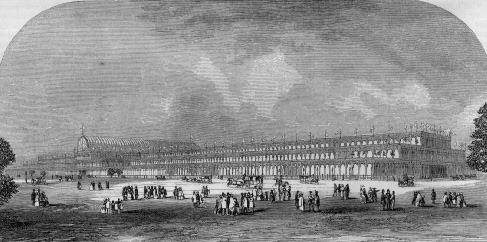
George Paxton, Industry of All Nations, 1851
and here:

The Crystal Palace did not just celebrate the technology that made modern liberal civilization run. It celebrated reason that had freed humanity from superstition, and celebrated the capacity of technoscientific reason to improve the wellbeing of human beings, increase the wealth of nations, civilize society and make liberal civilization the high point of history.
Dostoevsky's Notes From the Underground stand for the break out from the Crystal Palace. It's a philosophical text, in that it holds that the Christian belief in God declining; human beings lost their moral bearings, and waft directionless in the tempest that is life. Instead of liberating human beings for the better, the scientific Enlightenment had renounced the spiritual connection.
So there stands Nietzsche and his thesis of nihilism.
This initial romantic critique of reason/technology/utility was then taken up by the French surrealists, and more particularly by Bataille. This is the crucial link between then (1851) and now, and it is focused on finding an expressive realm that trangresses the everyday routines of a rationalised society
So we could read Norris through Bataille and the surrealist interpretation of Nietzsche. We had surrealism as an art movement in Australia in the 1940s, but did we have its philosophical interpretation?
Is postmodernism a repetition of Romanticism in viewing knowledge as a local, poetic and narrative construct? Is it the appearance of the missing philosophical expression of romanticism in Australia?
I would suggest that both Romanticism, surrealism and postmodernism are reactions to, and critiques of, an instrumental Enlightenment reason.
|


hmmm...just on that point about the "romantic critique of reason/technology/utility", there are now technotopians who celebrate the notion that technologies (particularly digital and network technologies) free us from linearity, from reason, from "molarity", to paraphrase their pet theorists Deleuze and Guattari. Modernistic in one sense (technological advancement-->brave new world; avant-garde celebration of impending disruption of the dominant order)but in others quite distinct from industrial modernism...then you have the open source/open content movements which encourage the proliferation of culture and the flattening of economic and value hierarchies...anyway, interesting stuff in this post, Gary.