|
December 29, 2003
I saw Rolf De Heer's 2002 film The Tracker last night on DVD.
The only other film of De Heer's that I'd previously seen was his 1993 film Bad Boy Bubby. I recall that I was deeply taken with the first 20 minutes of that film, where Bubby, the man-child, is trapped within a domestic hell-hole with only his abusive mother and a dead cat wrapped in plastic for company. From memory, the rest of the flim did not shock and disturb, as it was conventional in its handling of the narrative.
I was deeply impressed with The Tracker's painterly representation of the Arkaroola landscape. This was informed by the colour of Peter Coad's paintings:
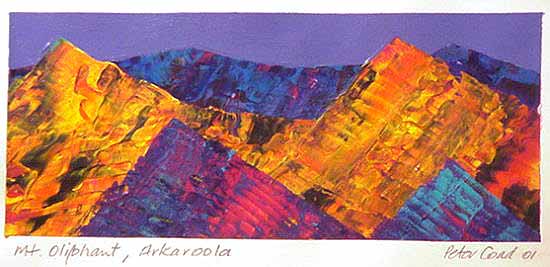
P.Coady, Mt Oliphant, Arkaroola, 2002
The colours were red earth, blue sky green trees and blue water:
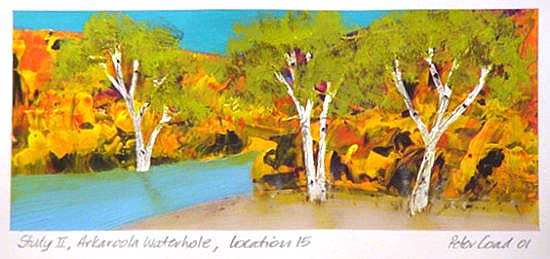
P. Coad, Arkaroola Waterhole, 2002
What I also noticed three innovative techniques. The Tracker made extensive use of Peter Coad's paintings in the film to depict the white violence toward indigneous people, thereby incorporating indigenous story telling from. Secondly, we have the use of song by Archie Roach instead of script to comment on the characters and actions in the landscape. Graham Tardiff’s music (with lyrics written by De Heer) is reminiscent of Neil Young’s evocative score in Jim Jarmusch’s Dead Man. Then we have the use of the narrative to represent the intersection between white and black cultures in the early days of post-colonial Australia (1922). And the camera draws us into the landscape so that we walk the valley's within a slow 'desert' time.
The significance of these techniques?
The film enables we Australians to cross the traditional line in which we viewed the landscape and indigenous people through the white colonial eyes as a terra nullius. We traditionally pictured indigenous people through Social Darwinism and viewed them as stone age savages. The techniques enabled indigenous Australians to speak in their own voices opened up a space in which to we can begin to see the country from the perspective of indigenous people. That is the innovation of this film, when compared to Rabbit-Proof Fence.
This visual poetics is a big step to an Australian cinema.
|


couldn't agree more - the songs and the paintings as alternative "narration" stood out for me too.