|
August 21, 2005
I've often remarked that in Adelaide the public spaces in the inner city are frequently empty with people walking about and that they are dominated by the car. Similarly in Canberra. Both stand in contrast to the reinvigorated urban life in Copenhagen.
Adelaide, for instance, is making no attempt to reduce car parking places and restoring pedestrian zones to reinvigorate a decaying urban core. The car rules, period. It does not have congenional public places apart from the parklands. For our conservative city fathers the car=business=commerce. The city space is about commerce period.
The urban mode of life in the Gold Coast in south eastern Queensland is even worse, judging by these two cartoons:
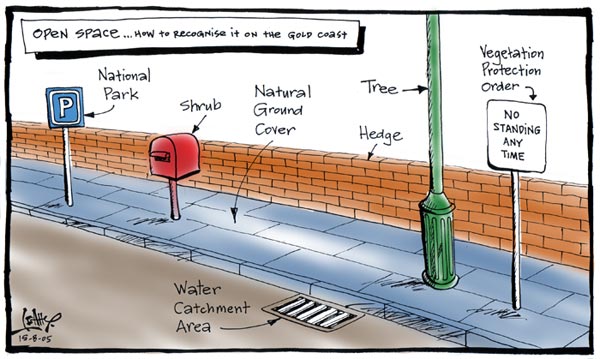
Leahy, Gold Coast City Council definitions
And:
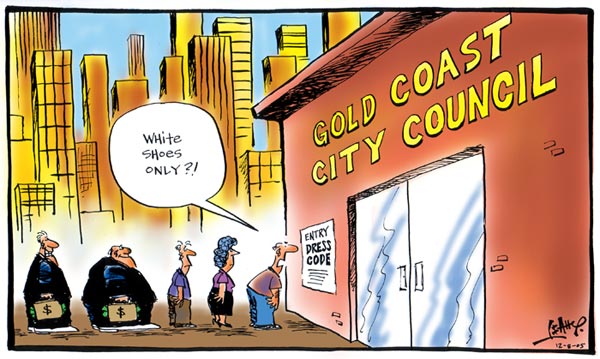
Leahy, If the shoe fits...
The decline of public spaces is not just a question of cars dominating our cities. We have heightened security measures and camera surveillance, and the indifference to the public by those who think that the internet and their families provide all the social interaction they need to live flourishing lives.
Canberra has gone--it was designed in the early 20th century for the car, not for walking. The best that Canberra can hope for is the ongoing revitalization of the inner suburbs of Manuka and Kingston.
But as Adelaide was a nineteenth century city it can still re-invent itself like Barcelona and Lyons, and so become a great people-friendly Australian city. Same with Hobart in Tasmania.
|


I was part of the car culture in Australia I had a hotted up 1962 EJ Holden. Earlier I had a Datsun that was white with a massive blue wave running up it. I am part of the car culture in the US too, I own two Corvettes which I have taken to shows and the like. I also go to most of the local car shows which is usually enthusiasts displaying their muscle cars from the 60s and 70s.
As to the environment I live in, Nth Virginia is like Schofields or Castle Hill in Sydney. It is surprising how similar the layout is. I dont think it is Australia copying America, or vice versa, I think they are similar due to economics. Developers have worked out how to extract the maximum revenue from a tract of land. This leaves the new developments around the world looking the same.
The other aspect is, I have no local shopping centre I can walk to. In our area we have the massive malls which put Paramus NJ to shame. Like the Dulles Town Center. But even if stuff was close, would I walk anyway, or would I jump in the 'vette?
Dont know.
The mid-atlantic US has some pretty nasty seasons. It is too cold in winter to walk to the shops, and in summer it is too muggy for most people as well. But in the end there is no choice, because economics has removed the corner shop and replaced it with mega-marts. The cost of centralisation of our goods is that we have to travel to them. But it also means I have four different ones to choose from within a five minute drive.
But then again, I am human, I might choose to drive anyway...