Thought-Factory.net Philosophical Conversations Public Opinion philosophy.com Junk for code

Mandy Martin, Puritjarra 2, 2005. For further information on MANDY MARTIN, refer here: http://www.mandy-martin.com/
If there are diverse kinds of knowledge and ways of knowing place, then we need to learn to value the different ways each of us sees a single place that is significant, but differently so, for each perspective.
RECENT ENTRIES
SEARCH
ARCHIVES
Library
Thinkers/Critics/etc
WEBLOGS
Australian Weblogs
Critical commentary
Visual blogs
CULTURE
ART
PHOTOGRAPHY
DESIGN/STREET ART
ARCHITECTURE/CITY
Film
MUSIC
Sexuality
FOOD & WiNE
Other
www.thought-factory.net
looking for something firm in a world of chaotic flux

an i-pod world « Previous | |Next »
April 2, 2006

Here's what we know about the changes in music towards a digital world according to Alan Kohler:

Music and video are going entirely digital. It won't be long before CDs and DVDs are obsolete as storage. The new device of choice is the iPod, which is in the midst of an incredible global boom that is enriching Apple and its shareholders. The only place you can easily buy material for your iPod, as opposed to stealing it, is the iTunes online store.

I have yet to buy an iPod, even though I find the platform quite seductive and very desirable.
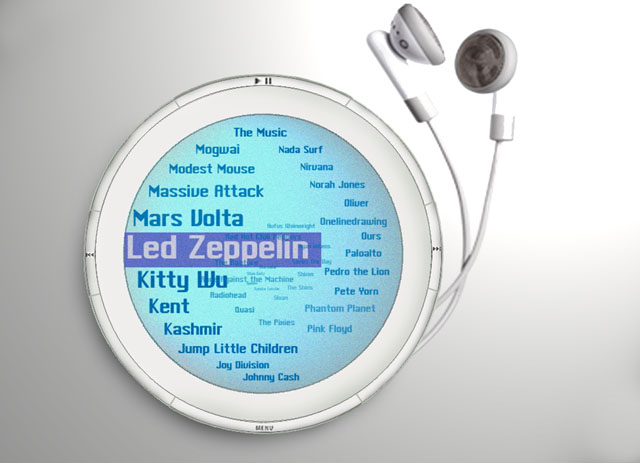
Apple.jpg

I'm holding off, though I''m not sure why. I suspect that it is because Steve Jobs has again stuck with closed architecture and total control , given the vertical monopoly to lock iPod users into using the iTunes Music Store exclusively. Or maybe it is because I was burned badly with the early and very expensive Apple computers that crashed on me. Or maybe it is because we Australians cannot buy TV shows on iTunes as Americans do. For the moment I will stay with my CD's and stereo and watch what happens.

Kohler captures the attractivness of the platform, when he says:

With iPods and iTunes, Steve Jobs and his team at Apple have created a beautifully functional closed system for selling and consuming digital music and video that looks to be heading for total dominance...The record labels have to deal with iTunes or face oblivion as the iPod population grows...iTunes is efficient and seductive. You register with Apple and provide your credit card details. Then you browse the store or search for the song or artist you want. One song is $1.69, albums $16.99 or $17.99. You click it, and --- zip ---you've bought it, credit card debited. Plug your iPod into your computer and the music is automatically loaded.

Kohler says that he no longer uses a stereo that plays CDs as I still do. He just sticks his iPod in the top of a box of speakers that he bought from Apple's iTunes Music Store. He says that the sound quality is great and his entire record collection is now in the iPod.

Hmm. I'm still not convinced., despite the great marketing campaign by Apple. Kohler then adds:

I might be wrong, but it seems to me the ability to easily buy a single, new episode of a TV show (and repeats), as well as single songs, albums, movies and music videos in a form that is easy to watch or listen, will change everything.

I reckon he's right there. I cannot wait for it to happen.

| Posted by Gary Sauer-Thompson at 11:37 AM | | Comments (8)
Comments

Comments

Things are changing but as always the consumer will win over the closed systems people.

An iPod plugged into an Apple "HiFi" is about as far from real HiFi as your average boom box for $100. It will suit many or most people but not at its current price of $550 for a box. Calling 80mm drivers mid range rather than the more accurate tweeters and a 130 mm driver being called a woofer is material for the ACCC in my view. I suppose this suits the people who live (or imagine or wish they do) in minimalist polished floor boards stainless steel kitchen(ettes) inner urbans apartments. But it aint HiFi.

This is the first era whereby the artists, producers and hardware sellers and punters are not pursuing higher fidelity. For the first time ever we aren't all in a rough coalition together toward better sound capture, transport, storage and reproduction.

Closed source will satisfy the mass market as always. (As a sideline it's interesting how long Apple particulaly will be able to position its mass market strategy as "cool", "leading edge" and somehow "edgy" and niche). But open source will be what endures and undermines closed.

As well as ceasing to pursue greater fidelity we are now faced with the music coming the the listener without effort. The iPod pops in the pocket with 80 gigs of MP3s and walks with us to work, train, toilet, whilst reading, bushwalking and making sexual horticulture. It arrives via broadband downloads easily searched without any great effort or even screening for taste and talent.

Once music required handling 12 " LPs in and out of covers, balancing tone arms, setting needles / stylus tracking,eliminating hum and rumble and feedback and not scratching the holy discs. It involved getting up and down from seating every 40 minutes or so at least. Maybe more frequently. It involved building speakers with drivers 10" or more as woofer, midranges 6 " and tweeters 3" or less. In a box that was solid and didn't rattle. Then it had to be positioned to get true stereo sound staging, depth and clarity and the sitting in the right spot, triangulated. Effort.

Finding the music to play meant chasing down old albums, reading obscure magazines, acting on the word of someone to be trusted, scouring record shops, meeting a fellow nerd, swapping treasured albums, ordering in from overseas without hearing, trading live concerts in a secret underground cabal of tape mixing geeks and fans. And concerts. It meant going to the music . Now the music comes to us. And I think its less exciting and rewarding for that. Certainly less community building.

Despite the convenience of the iPod (I use iPod as a generic term for iRiver and any MP3 or compressed such as flac, .shn, monkeys, transport and listening device, which I believe will increasingly come to be dominated by the non moving USB plug) the convenience which brings the music to the listener without effort there is still a satisfaction to be found rummaging in old record bins and handling cover art whilst dropping the needle on an old Stylistics hit. Who would want to play Cage's 4'33" on anything but vinyl.

eThings will indeed change - in the mainstream. They have already. There will be no more Rolling STones who will sell stadiums (at least for a few years until a retro backlash hits) it will all be low-ish fi bedroom, earphones on train music.

But who would have guessed it - the big resurgence, on the streets, in my small world, is guitar bands, usually but not only neo-heavey metal and not suited to bedrooms or personal space - it demands to be performed - it demands you go to meet it - in a bar or somewhere. Yes it changes. But it always changes in uncontrollable ways. And those ways it splashes in will not be controlled closed source ways. Apple will make money, but fresh music will survive in spite of and because of.

Francis,
I'm not sure that I want to return to the "good old" record days. I have little nostalgia for that time. I'm quite happy with CD's and a good stereo, even though the iPod is the great pop cultural phenomena of this decade.

I just wish CD's weren't that expensive. Still, that expense makes me very careful in what I buy.

You express my unease with the Apple music platform very eloquently. Kohler does say that the closed Apple system will quickly get pushed to oneside by Microsoft--as they were with computers in the 1990s.

I do hope that open source architecture wins out.

We have an iPod and nanoPod. The itunes store isnt an issue as 99% of our music is mp3 from CDs or from bands/friends we know. I think we have bought a grand total of about thirty songs through itunes.

The real curious thing was that the iPod replaced our big stereo. It is one of those stand up things that has radio, cd, turntable etc etc. Massive speakers. A lounge room furniture hog.

Our entire collection is on the iPod and with the bose speakers we bought it sounds as good as the big system. The iPod stays in its stand in the loungeroom - it is effectively our music center now.


I didn't mean to sound as if I was against digital sound, I'm not. After all CDs are digital and far superior to vinyl in sound, storage and convienience.

I have been using .flac and shn for years (mainly for storage) and had tried to set up a PC playing through the sound system years ago. It had (still does) too many problems, needed a monitor, pc was noisey, there was hum introduced in the line that couldn't be eliminated etc. I'm not a high end snob but I do have a problem with having all (most) of my music in a lossey format. The price it would cost me to go all digital now is pretty high, I reckon on $1,000 to set up with different systems. I've got a very small thumb size MP3 player but I don't listen on ear plugs much and it doesn't store enough to use on my systems.

I don't yearn for the "good old days" of vinyl. But I think it is an important issue how different the discovering music journey is these days.

The change in what used to be a fairly universal coalition of punters, musicians, producers, hardware makers to pursue "better" sound of high-er fidelity has been shifted to a pursuit of portability and a lowering of fidelity. I'm not convinced it is the end of civilization as we know it but it is a significant shift. So whilst a small mob of hi-end audio-phools carefully produce (overhyped) SACD in an effort to capture more sound on the disc the majority of the population is listening to a lossey compression rate of about 128 kbs or even 64kbs, and paying for sound that tosses away a great deal of information the recording tried to capture.

Maybe it was always a bit thus. Most people became enthralled with their favourite music through tinny car speakers in the good old days. Myself I first heard "hey Joe" by Hendrix and "My Generation" by The Who on a crappy crystal set I built myself. Didn't seem to lessen the impact.

The shift to the pursuit of portabilty has also shifted the way music is listened to and I assume how it is understood and absorbed. It certainly has opened up the distribution and production by enabling low cost(or nearly no cost, except oppurtiunity cost, as most of the hardware and software costs of recording are sunk costs or costs assigned to other activities) recording to digital and subsequent distribution either through pod to pod or the net.

If I was starting from scratch I would go with a digital system that would play lossless compression although the cost of storage is so low that compression is hardly needed. My problem is really my legacy hardware systems that still deliver good sound and legacy storage, vinyl singles and LPs and CDs. My understanding is that most pay digital online servers do not offer a lossless compression option yet to download.

I'm also pissed off about DRM. But that's another story

Francis,

I too tried to set up my PC playing through the sound system. I found like you that:

It had (still does) too many problems, needed a monitor, pc was noisey, there was hum introduced in the line that couldn't be eliminated etc.

My problem is not "my legacy hardware systems that still deliver good sound and legacy storage.... and CDs." I've just acquired them.

When you say that:

If I was starting from scratch I would go with a digital system that would play lossless compression although the cost of storage is so low that compression is hardly needed.

Do you mean something along the lines of what Cameron has done---an iPod plus bose speakers?

Something. I should clarify some of my prejudices. I like to set up system(s) to cater for what I call active listening. That is listening where the listener is sitting between two stereo speakers at the "sweet point". That is the point that gives optimum seperation, soundstage, and maximises midrange and delivers adequate controlled bass. Genrally this is a bit like a triangle - two speakers probably at least 2 metres apart slightly kicked (angled) in toward listener and about 2 metres + from the listener. Room well damped and tweeters at about ear height. This set up is for active listening whereby one is almost exclusivly focussed on listening to the music.

Now this isn't how all or even most people listen. Mostly people do other things whilst listening. I listen while cooking, while walking around doing stuff, and while reading and there is also background listening - my least favourite kind - where the music is turned down low and is merely a background for a meal or conversation, then theres party listening where the volume is loud and bassy.

All have their place. My approach is generally to set up for active listening and then that can also cater for the other types of listening with a few tweaks.

The Bose system that Cameron mentions is (as are most BOSE systems) set up for non active listening in that it aims to fill the room in a diffuse way not in a way that sets stereo and sound stage and sweet points. That seems to be how most music is listened to, indeed I probably listen to most music that way. But the real satisfaction mostly comes from active listening positioned between the speakers.

In an ideal world, I would have all my music digitalised,[4,000 vinyl albums, 500 singles, 1,000+ CDs] and playing through a solid state amp X reciever into two speakers with large mid range drivers and woofer drivers and perhaps an active sub woofer. The iRiver or iPod would slip into a slot on the amp and there would be a remote with a screen to view info and control volume and tracks. Ideally the amp would have multiple speaker outputs to drive 3 sets of speakers inside and two sets outside - one set in garage and one set under eaves on back deck BBQ. Until then I have I have 4 seperate set ups inside, all have CD players and reciver amp and two have turntables for vinyl. The outside and garage has receiver amps with CD only. For singles I have the juke box (in need of expensive repair at the moment)which takes about 90 at a time. Most of my gear has been good second hand gear and hasn't cost me a fortune but delivers as good a sound as most hi-end audiphools only hope for at 1,000s more $.

I didn't mention I'd be going for a digital player that copes with .flac or .ogg or lossless compression and I'd be backing it up and changing it around regularly.

The iAUDIO X5L is one 30G that does lossless .flac and ogg. There are others.

i use a cheaper mp3 player. and it's great.
the plug and play system of storing is great. I'm looking with envy to all Ipod users i see at my every day train journey to work. it looks so cool, and as a past Mac user, i do remember the remarkable user interface they used to create, the ipod looks like the natural next step, and in few years no doubt we will all move it to digital music listening gadgets.
only the *freak* will go on listening to old records and Cd's
lets face it, even today, i can be bothered with opening the CD envelope, placing the CD inside..taking it out..etc..i need data to be *invisible* and instant to use ":)