
Mandy Martin, Puritjarra 2, 2005. For further information on MANDY MARTIN, refer here: http://www.mandy-martin.com/
If there are diverse kinds of knowledge and ways of knowing place, then we need to learn to value the different ways each of us sees a single place that is significant, but differently so, for each perspective.
|
|
looking for something firm in a world of chaotic flux
|
|
|
revisiting modernism
« Previous |
|Next »
|
|
|
June 20, 2006
An article on modernism in The Guardian. It says that:
gradually the meaning of "modernism" settled down to its present form, based on utopian fancies, standardisation, industrial materials like chrome and plate glass, abstraction and a vehement ambition to make a new world, not just a new art. Design - the rethinking from zero on up of everything from teapots to whole cities - was imagined as potentially all-powerful
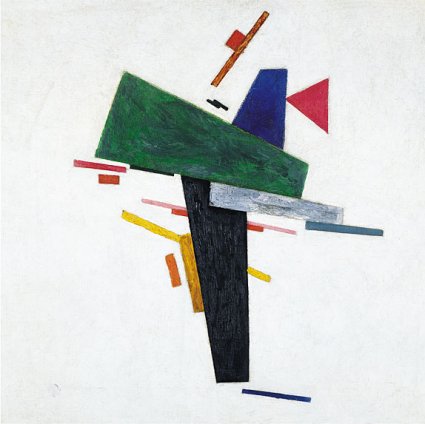
Malevich,Untitled, 1916
The new looks old doesn't it.
If you didn't believe in progress, you couldn't call yourself a modernist.....The prime building material of progress, of the longingly desired postwar utopia, was glass. Glass had several symbolic qualities to recommend it. First, its fragility. People remembered the gaping window frames, the shattered and empty openings, left in the wake of the great war. A society with intact glass buildings, manifestly, was a society at peace. Then, not only was glass fragile: with the correct framing, it could be very strong (though not in bending) and amazing feats of structural daring could be executed in it.....Glass was the very opposite to heavy stone and opaque brick. Light streamed through it, the light of heaven itself. This offered social redemption. Glass forms, crystalline and suggestive of weightlessness, seemed to be the stuff of transcendence. Glass carried implications of myth, of other, soon-to-be-built Crystal Palaces
|
|
|
|
|
|
|
|
|
|
|


