|
May 1, 2007
Simon Reynolds, the author of Blissed Out and Rip It Up And Start Again, and creator of Blissblog, has a new book entitled Bring the Noise: Twenty Years of writing about Hip Rock and Hip Hop. It brings together Reynolds’ writings since Rip it Up and Start Again, which looked at f the post-punk sound that developed at the end of the seventies.
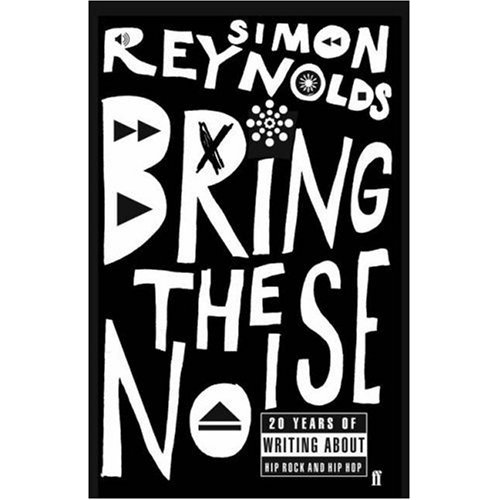
The book has just been published and so I have yet to read it. What we do have is an interesting interview with Reynolds at Fact Magazine by Mark, who runs K-Punk. I've picked out the section on 'rockism.'
K-punk observes that Reynolds situates the book as picking up the story where Rip it Up left off, but the attack on 'rockism' originated with post-punk, and then asks: Is the reclaiming of 'rockism' an unlearning of post-punk orthodoxy, or can your take on rockism be seen as in some ways continuous with post-punk? Reynolds responds:
Obviously, the idea of rockism as a bad thing, a blinkered mindset, was a really useful initiative when first mooted in post-punk days, and it carried on being salient and productive for some time after that. There are many aspects of rockism that remain worth attacking - privileging of the electric guitar; any approach that fixates on the song and sees rock as form of surrogate literature, the songwriter as story teller; limiting notions of authenticity, et al. I would agree with those who argue that rockism actually limits one’s understanding of rock music itself, of where its power lies.
Fair enough. Guitar rock certainly ran out of innovation and the music became pretty uninteresting. Reynolds interprets anti-rockism as a self-correcting move within rock discourse, a way of restoring a kind of suppleness and open-ness to an ideology that had become calcified and restrictive. However, the music of the late 1960s and early 1970s also created an alternative tradition that saw rock’n’roll as Dionysian, chaotic, intense and as an unsettling of empty mainstream music. It was a way--an historical way--- of experiencing music as intoxicatiing and rapturous. That was a period when music was driving center of the culture, rock and roll understood itself to be part of the modernist avant garde and the fans were blissed out and celebrated excess.
Reynolds qualifies his embrace of anti-rockism. He says that the anti-rockist polemic, which resurged this decade, seems to have developed a kind of runaway momentum, a malign logic that some people followed through to absurd places. He spells this out:
There seems to be a drive towards eliminating all axes of judgement beyond pure pleasure, the supposed purity of the consumer’s unmediated experience of the pop commodity. The distinction between “urgent” and “trivial” is obviously a no-no for these heroic anti-rockists, but you even get people seriously debating whether distinctions based on quality - good/bad - are rockist and should be jettisoned.
So I began to realize a few years ago that it had moved beyond an attack on the idea that guitar rock alone had a special claim on seriousness, art status, rebellion, etc to the rejection of those ideals altogether—the whole complex of values to do with innovation, edge, danger, difficulty, subversion, disruption, notions of music as underground or oppositional, as either “art” (vision, expression, etc) or “folk” (social energy, collectivity, the real). This is all stuff we’re supposed to jettison, not just as something no longer applicable to the current situation, our scaled-down expectations,but as something that was never valid, was always fraudulent .
Reynolds adds that he started to feel quite comfortable with the idea of being a rockist, because all the eras and genres of music that have meant the most to me - Sixties psychedelia, post-punk, rap, rave, grime - are riddled to the core with those values. They might not have electric guitars or husky-voiced vocalists but they are all based around what are apparently irredeemably rockist ideals. So rockism, in this larger sense, means the whole apparatus of importance, relevance, seriousness, music as a force for change, significance, authenticity and subversion.
|
|


