|
May 17, 2008
Surprisingly, cities did not rank front and centre in Prime Minister Kevin Rudd's 2020 summit. They were pushed into the background in spite of the effects of climate change, water scarcity, urban sprawl and rising petrol prices. There is a lot of rhetoric about making Australia's cities more sustainable and liveable, but little action.
Melbourne, for instance, is supposed to be turning away from urban sprawl, with the Melbourne 2030 blueprint being used to control the city's growth, make the city more compact and affordable, and less car-dependent. Royce Millar and Simon Mann say in The Age that the Melbourne 2030 blueprint's
central thesis was to move from a city-centric hub-and-spoke landscape to one of a network of almost self-contained commercial and community centres. Car dependence and greenhouse emissions would be reduced through the building of stronger local economies and communities allowing Melburnians to live, work and play in their own neighbourhoods. Though how that was to be achieved was never exactly clear.
The reality is otherwise. Melbourne's outer suburbs have expanded as fast as ever, public transport is under great pressure, there are commuter bottlenecks (the West Gate Bridge) its growing faster than all other state capitals, greenhouse emissions continue to rise.
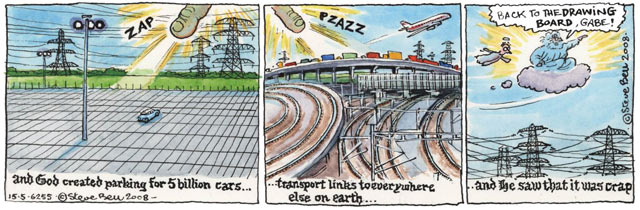 Steve Bell
Suburban residents are still hostage to the car, Melbourne is still dominated by the car, and those on migrate to the fringe for cheaper housing end up stranded away from jobs and infrastructure.
|


