|
May 2, 2008
Photoforum showcases New Zealand photographic work and, from all accounts, it is run on a shoestring with lots of volunteer labour, gathered around the editorship of John B Turner. It is part of the art institution and the people associated with this non-profit society have historically aimed to:
showcase local talent, critically inform, stimulate and challenge New Zealand photographers to develop their ideas into a tangible body of work, as a portfolio, essay, exhibition, or book.
They organise exhibitions, workshops and lectures, produce a magazine MoMento and run their own blog. The work nurtured is primarily that of contemporary photographic artists and social documentarians.
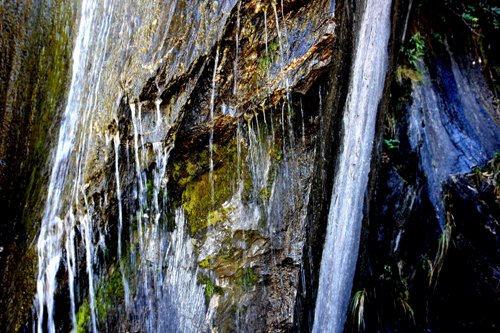 Gary Sauer-Thompson, waterfall, Waiho River, Franz Josef Glacier, New Zealand, 2008
What surprised me about Photoforum when I rediscovered it whilst surfing the internet when in NZ was the absence of the work of landscape photographers, such as Kate Pedley and Daniel Murray. They did not appear in PhotoForum's survey of contemporary New Zealand photography in 2000--The Active Eye.
In exploring those photographers selected back in Australia I realized that these two digital-based wilderness photographers started their work after the survey, and that the survey took us up to the beginning of the digital revolution in photography. If a customary definition of landscape is a portion of land which the eye can comprehend at a glance, then the contemporary understanding of landscape includes the sense of it as a cultural convention shaping the way in which we envision and construct the natural world.'
Closer examination of Photoforum indicated that the Active Eye's understanding of the category 'landscape' was idiosyncratic, as it included images that were not landscape and it contained only a few images that could be understood as wilderness photography. It did not include the work of established wilderness photographers, such as Craig Potton, and Andris Apse and Rob Brown.
My judgement is that there is a big gap between photographic work produced in art circles and those wllderness/landscape photography working outside art circles who are not commercial-only photographers.
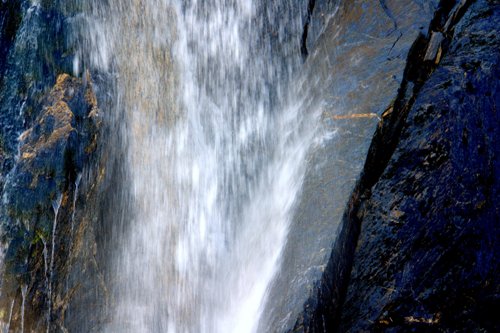 Gary Sauer-Thompson, waterfall, Waiho River, Franz Josef Glacier, NZ, 2008
Do we infer that wilderness photography is not landscape art? Or is that landscape photography has become unfashionable in the art institution because of its pictorial or picturesque conventions? These make it pre-modernist for the modernist art institution and so a decayed artistic style.
Could not the picturesque be considered as an aesthetic category that is a combination of the sublime and the beautiful and is midway between the the most violent aspects of the sublime and the most tranquil forms of beauty, and so a reduced, gentler, less exalted form of both? As such it is mode of perception, a particular set of artistic conventions and an interpretation of the landscape. It is one that is based on the idea that beauty does not reside in some objective property, like symmetry or proportion, but rather in gestures that both train and associate our memories or emotions.
New Zealand artistic culture attempted to humanize modernism with picturesque asymmetries and a touch of robust popular culture.
|


Gary
While the sublime strips and objectifies nature, the picturesque gives it a subjective and romantic image. The picturesque literally means picture-like, and involves seeing the natural world as divided into generic artistic scenes. Images of ruined castles, a lonely tree in the puszta and images of seaside villages come to mind.
Modernist artistic practice adopts a critical stance towards the picturesque, either by depicting a landscape that does not correspond to the conventional categories of the picturesque, or by deliberately drawing our attention to those categories.