
Mandy Martin, Puritjarra 2, 2005. For further information on MANDY MARTIN, refer here: http://www.mandy-martin.com/
If there are diverse kinds of knowledge and ways of knowing place, then we need to learn to value the different ways each of us sees a single place that is significant, but differently so, for each perspective.
|
|
looking for something firm in a world of chaotic flux
|
|
|
Lewis Baltz: the question of the medium
« Previous |
|Next »
|
|
|
March 5, 2009
In this interview at American SuburbX the American photographer Lewis Baltz says:
I've never had any profound loyalty to the idea of photography as a medium but simply as the most efficient way of making or recording an image. And that has changed over the last few years. Now the most efficient way is to work with digital or with digital-analogue or between the two. Eventually, I'm sure it will be entirely digital. It's simply the prevailing technology, the available technology now. I think in the future we won't even have a choice.
Baltz’s early black and white photographs depict the architecture of the urban landscape, and were often displayed in Minimalist grid-like structures. Devoid of human presence, these images of blank concrete walls and characterless buildings suggested abstract paintings. Some of the minimalist pictures included nature:
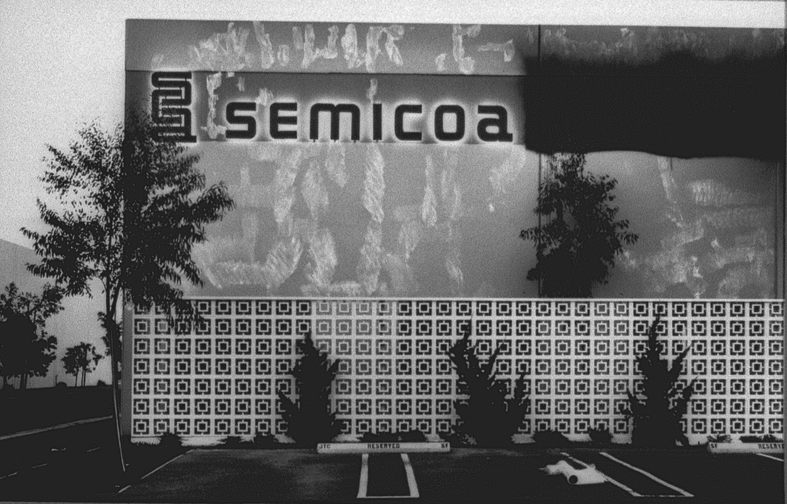 Lewis Baltz, North Wall, Semicoa, 333 McCormick, Costa Mesa, from the series New Industrial Parks, 1974
His early "topographic work", such as The New Industrial Parks, Nevada, San Quentin Point, Candlestick Point (84 photographs documenting a public space near Candlestick Park, ruined by natural detritus and human intervention), exposed the crisis of technology and urban life. The pictures describe the architecture of the human landscape, offices, factories, and parking lots. My interest is in the Candlestick Point work:---a series devoted to an area near San Francisco that urban renewal had overlooked. This is a landscape defiled by human waste.
 Lewis Baltz, National Centre for Meteorological Research, Grenoble, circa 1989-91 from series Sites of Technology May 17 - Jul 15, 2008
Sites of Technology traces Lewis Baltz’s journey through the workplaces of information technologies in Europe and Japan in the early 1990’s. In the interview Baltz goes on to observe that:
The questioning of the photograph in its relation to the reality, the interrogation of representation, the famous crisis of representation, really all took place before digital technology. Digital technology, you see, is not the villain here. It simply offers another dimension. I'm not sure if it's a farther remove from reality than analogue. I think if we can speak of reality, if reality and representation can be spoken of in the same sentence, if reality even exists any more, digital is simply another way of encoding that reality. I don't think it's farther from or, for that matter, closer to this concept of reality than anything that came before. I don't think the question of "materiality" is really what's at issue here. Photography is less material than painting; digital is less material. But the dematerialisation of art again is something that began thirty years ago as a conceptual gesture and long before people realised that it was not only a possibility but would in fact become the dominant technology.
He says that the contemporary artists simply take for granted that all these mediums such as computer, video, photography, film are available and have their particular qualities. Consequently, they modernist question of medium is something that seems to be disappearing.
|
|
|
|
|
|
|
|
|
|
|


why the turn back to Baltz?
The title Topographics is misleading for this work. It refers back to the US topographic tradition of the 19th-century surveyors--such as Carleton Watkins and Timothy O'Sullivan. However, Blat'z's work also refers to Minimalism. If the pictures are bare and spare documents of urban sprawl, then they are also stripped down to an essential, rectilinear geometry.They are high modernist.