|
March 25, 2009
There is an exploration of the issues surrounding graffiti and street art on the ABC's Radio National by Brendan Trembath. It is entitled Graffiti, art and fear. Adelaide was not mentioned---only Sydney and Melbourne:
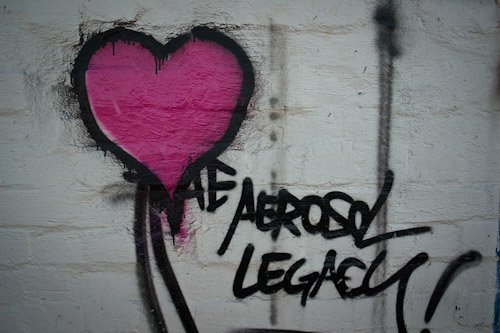 Gary Sauer-Thompson, purple heart, Waymouth Street, Adelaide CBD, 2009
Dr Lachlan MacDowall from the Centre for Cultural Partnerships at the University of Melbourne says that graffiti in Australia in a way goes right back to the indigenous inhabitants of the land. They've obviously adapted the landscape and marked the landscape in all sorts of ways. There's also traces of 19th century graffiti in Melbourne on some of the bluestones, and traces of some of the convict years in Melbourne.
He adds:
But I guess the real heydays of graffiti is in the post-war years where we can still see today some examples of political graffiti from the '60s and '70s, graffiti protesting the Vietnam War or changes in Australian politics. But the key date really for graffiti in Melbourne is in the 1980s when some of the graffiti traditions from New York arrive in Australia via music video clips or films, the documentary films of the New York subway graffiti. And that's the form that becomes dominant over the last two decades. And it's the form that Australian artists have adapted and adopted for their own planet interests. And more recently we've seen I guess, a return to more politicised graffiti and the rise of stencil graffiti in Melbourne, since the turn of the century's been well documented. And we're now at a phase I think of seeing a collision of some of these styles, some of the old-school tagging and mural graffiti up against some of the newer, more figurative and perhaps more political forms of stencil graffiti.
Andrew Mac, who has a gallery overlooking Hosier Lane in Melbourne, says that in the recession years of the early 1990s as young artists we wanted to expose our art to a lot of people and I guess that was inspired a lot by graffiti and street artists use of the street.
It's about kind of taking back public areas in order to show your work and reach a larger audience than you can inside a gallery......At the time I found building owners to be very amenable to the idea. These were back walls in alleyways, and I think people forget these days, because the alleyways are so used in Melbourne, they've become the focus of the city in fact. But in the early '90s they were still considered rat-traps and places where people just put the rubbish. So nobody really cared about their back walls, and I found the building owners quite happy to give us use of the back walls.
He adds that I think people often get caught up between graffiti as vandalism and graffiti as art. Not all graffiti is art, but not all graffiti is vandalism either.
|


