|
May 29, 2009
Paul Graham's photographs exist the space and tensions between photography as documents and photography as visual art. This British photographer works in this space by producing particular bodies of work that are structured in terms of books---the ones that I know are the early ones, such as A1--The Great North Road (1981-82 ) and Troubled Land. (1984-86).
 Paul Graham, Beware, from Troubled Land
These texts connected contemporary colour photography, large format cameras and the classic genre of social documentary whilst transgressing the narrative conventions of photojournalism and the 1980s conventions of art photography (eg., the staging of tableaux). The space is one of making bodies of work (twenty or thirty pictures) where images work together to build up a coherent statement. The book is the work.
In this interview he says:
The important photographers for me belong in that period from 1966 to 1976, mostly American, let’s say from “New Documents” to “New Topographics.” It was a profound creative period for photography. Szarkowski at MoMA radicalized things for photographers by creating an artistic territory to operate in that wasn’t there before. Before, you were either an editorial photographer working for magazines in a semi-documentary style, or a fine-art photographer making pictures of landscapes or nudes or rocks. He swept aside that division and showed that people like Diane Arbus and Garry Winogrand were making the most profound photographic work of our time, and though it looked like ‘documentary,’ it was far more than that, and it didn’t belong in magazines, but in museums. This was transformative: bringing ‘documentary style’ work into the highest museum of our country. It’s little appreciated, but was perhaps Szarkowski’s greatest gift—recognizing and defining a new artistic space.
New Europe was different, as the images were more poetic. Graham had connected with a group of German photographers who were quite distinct from the Becher’s Dusseldorf school, as they were mostly around Essen-Berlin and had ties with Lewis Baltz.
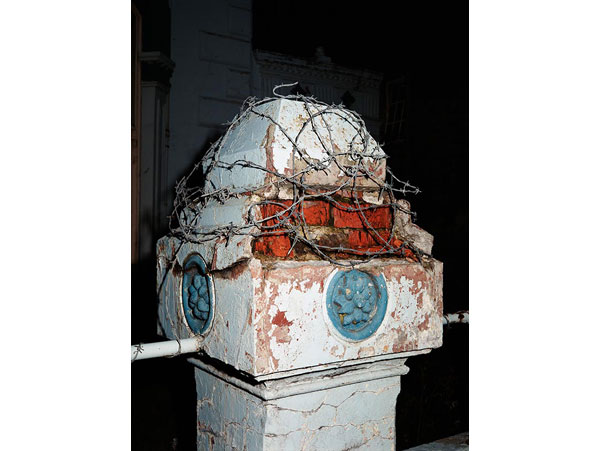 Paul Graham, untitled, from New Europe, 1986-92
Michael Schmidt, one of the Essen-Berlin German photographers, works in serial format, gathering together sequences of images that together provide a more nuanced view of a subject . This sequence doesn't tell a deeper or more linear narrative or story since it is more the relationships between a group of fragments or moments broadening our understanding of the rhythms of life buried underneath the surface. Schmidt's images are concerned with the burden of history and the uncertainty of memory. In his photographs of urban architecture, which are not simply physical landscapes but social ones as well, he provides a formally balanced but menacing portrait of the modern metropolis.
Graham's New Europe digs beneath the utopian dream of a united continent arising to face the dawn of the 21st century and reflects on the inescapable shadow of history that falls over each nation's conscience, from the dictatorships of and Hitler and the Holocaust This burden is interwoven with a questioning of the banality of modern day consumption-led culture.
|


