|
May 26, 2009
Australia is a regional culture that normally gets little or no mention outside its own shores--ie in American or Europe. So its recently written history of photography is largely unknown --an art history that is written in terms of a canon of a few master pieces by a limited number of celebrated photographers seen as creative geniuses who have individual styles based on pictorial innovation and power. These regional heroes do not figure in the art or social history of against background of Europe's historical imaginary of Australia as the other of Europe.
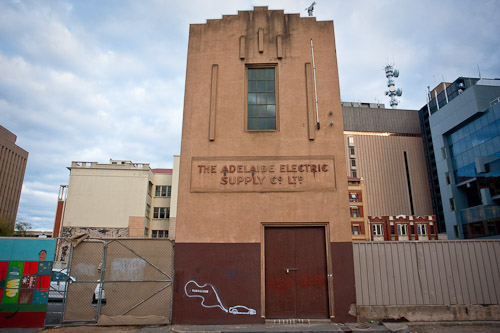 Gary Sauer-Thompson, The Adelaide Electric Supply Co, 2009
It's the old story of centre and periphery, dependency and innovation within a European vision and the common temptation to see Australia photography from the 1960s onwards as a dependent shadow of American photography. The Australian work is then seen as provincial, not original and formed by cultural subjection. It has an absent presence.
The 1980s is commonly seen by photographic historians such as Helen Ennis, Anne-Marie Willis and Geoffery Batchen -- as a a new beginning for art photography. A rupture from modernism as it were. The art institution----ie., the supportive network of schools, galleries, museums, magazines and public funding-- now had a substantive presence. There was the professionalism of the new generation of artist photographers, the diversity of their backgrounds, the interest in French poststructuralist theory, the emphasis on studio images and the turn away from truth and realism to excess and artifice.
However, if we accept poststructuralism's argument that photography's coming into prominence is broader than art photography. Photographic practices are embedded in a much larger assemblage of events, power relations, institutions and discourse, and these are coupled to the historicisation of vision So we need to broaden our perspective on photography in Australia prior to photography's shift from analogue to digital in the 1990s and the rise of the computers raises the question of the end of photography.
Geffry Batchen in an essay in Each Wild Idea: Writing Photography, History identifies several different photogrpaphies. There was the increasing use of photography as a form of social control by the state (the proposed Australia card and the use of a state driver's licence as a form of identification); the guerrilla campaign against (defacing) the photographic images on advertising billboards by B.U.G.A.U.P., debates over the truthfulness of photographed face of Lindy Chamberlain, the use of wilderness photography by the environmental movement to stop the Franklin dam in Tasmania from being built.
I would add the strong presence of amateur photography--what Geoffrey Batchen calls vernacular photography-- and the desire of photographers to preserve our architectural heritage.
This gives us the intersection of regional and international flows with photographers negotiating these intersections, and in doing so, producing what can be called the regional quality of Australian photography. That regional quality can be identified as the supplement and it needs to be recognized and evaluated in its own terms.
|


