|
January 31, 2010
I have just come across, via the City Room blog of the New York Times, Barbara C Mensch's photo documentation or portrait of Fulton Fish Market in Lower Manhattan and then New York's rapidly disappearing waterfront. She has also photographed the Brooklyn Bridge for nearly 30 years.
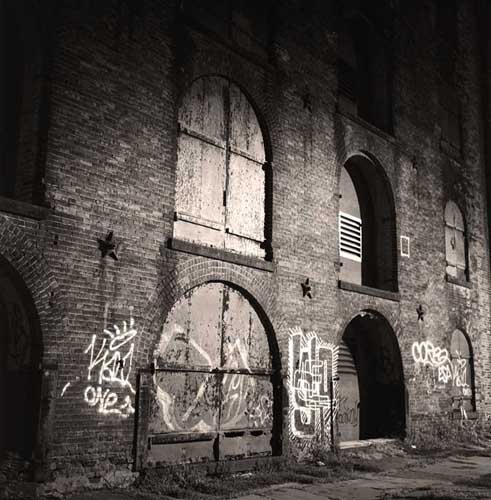 Barbara C Mensch, wall, New York
These are the worlds of yesterday as the profound change in the urban landscape of New York is sweeping away much of the city’s past. Mensch’s haunting images taken with a Rolleiflex medium-format camera are a reminder of all that was lost.
 Barbara C Mensch, Colgate, New York
This New York work reminds me of Eugene Atget spending years photographing Paris, unnoticed, going about his business.
The Fulton Fish Market closed in 2005, moving it to the Hunts Point section of the Bronx marking the end of a 183-year tradition of working-class life on the Manhattan waterfront.
 Barbara C Mensch, portrait, Fulton Fish Market
Mensch moved to an apartment near the seaport in 1979, which she has never left. Many of the images for Fulton Fish Market, recently published as South Street, were taken in 1979-1983, a time of profound change in the political and economic landscape of Lower Manhattan. The waterfront below the Brooklyn Bridge was targeted for economic revival, spurred by the demolition of important locales in the fish market, existing piers, working storefronts, saloons and hotels to make room for new commercial spaces, including a shopping mall.
Mensch's story in South Street ends with the closure of the docks and the opening of the Seaport mall, a symbolic victory of corporate interests over more than a century of working class life.
|


