|
January 6, 2010
In her On Photography (1977) Susan Sontag argues that photographs have the ability to change and expand our conceptions of the images that are both worthy of our observation and permissive of our gaze. Photographs represent a language of portrayal while embodying the ethical imperatives of cultural signification.
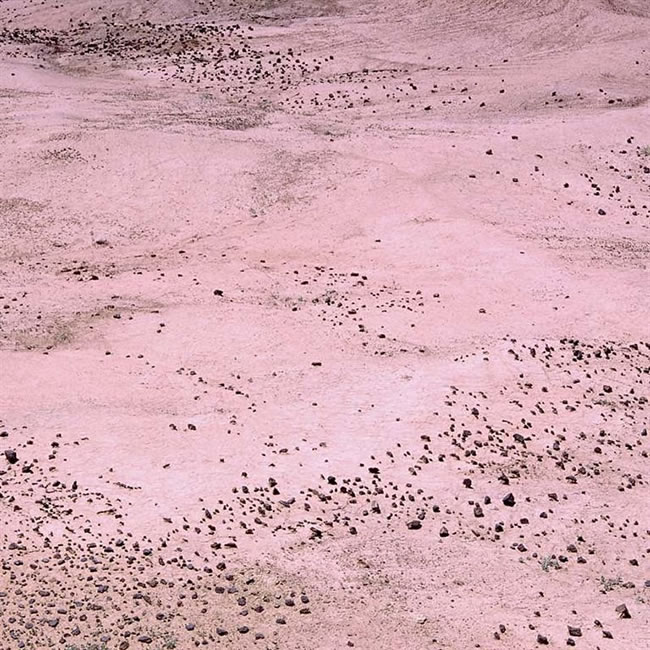 Stephen E. Strom, Rocks patterns, North of Many Farms, AZ from the Secets series
Sontag argues that a photograph provides a moment of actuality--it is a presencing of a moment, a depiction of the material experience of an object, scene, or individual, and a historical document. But a photograph also reflects a pseudo-absence. The full presencing of the subject can never take place in an image; once a moment is captured in stasis that moment becomes subject to interpretation and conjecture. Thus an image is not to be equated with disclosure.
The photograph provides access to depictions of beauty (such as a panorama) that are inaccessible to the eye. By doing so the photograph creates new meaning. But we also find that photography can be qualified for frames of categorization that form a narrative. The 'fragmentary continuities' that a lone photograph engenders may be appropriated into systems of information.
However, Sontag was critical of a photographic culture produced by the mass industrial production of images and specifically on the dangers of images:
The powers of photography have in effect de-Platonized our understanding of reality, making it less and less plausible to reflect upon our experience according to the distinction between images and things, between copies and originals.
Sontag was describing an "imageworld," which we had come to inhabit, and where we could only, and at best, maintain an uneasy distinction between the image and the real world by applying a "conservationist remedy," stemming the tide of visual pollution.
The inflation of images has increased since the 1970s and has produced a crisis of representation. In the digital era of hyper-inflation, in that many now hold that our sense of the distinction between the image and reality has been utterly destroyed. It is argued that we live now in the world of the hyperreal, the realm of the simulacrum, a virtual environment. Everywhere we turn today we are surrounded by images. The photograph is no longer an index of reality and images are no longer guaranteed as visual truth. Postmodern culture, then, is characterised by the "dominance of the image" and we learn to live wholly within the image-world.
It is the camera phone that has rapidly moved things towards Sontag's conception of a visually polluted image world ---what we have is a situation of feverish snapping to take images to provide a private memory of birthdays or weddings; or snaps of tourist spots of which thousands of images have already been taken. However, the camera-phone technology has also enabled events to be recoded raw from people on the spot by citizen journalists, thereby providing a public record of events and a public memory of something that might have remained hidden.
��
|


