|
January 9, 2011
The whole idea of a professional photographer is becoming obsolete as now almost every digital camera can create high quality imagery and so the difference between a professional and an amateur (quite important in Kodachrome days) is dwindling. Even picture agencies are now using amateur pictures who sell their images for a fraction of the cost of a professionally made image.
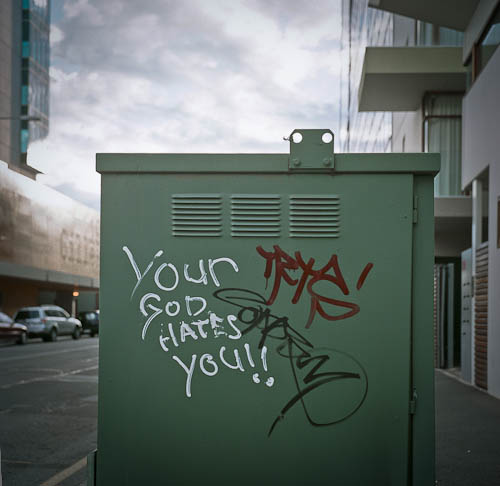 Gary Sauer-Thompson, Your God, 2010
Erwin Puts in his blog post on Photokina 2010 says that in the past a camera was a tool to implement a photographic vision. Now a camera is a consumer end product that happens to generate images that can be uploaded to Facebook or Flickr.
In another post---Socrates and Photography --he says:
Even when photography is an integral part of our visual culture and a major force in shaping our views and opinions of world events, most reviewers of photographic equipment still adopt the boy’s toy approach. The maximum number of pixels, the maximum number of lines per image height, the maximum contrast, the maximum speed of a lens, the maximum zoom range, the maximum shrinking size of a camera, the maximum number of features - the list is endless - define the stature and worth of a camera.
He says that perhaps it is time to put technique where it belongs: as a device for picture taking and not as an end in itself. This uses one's technical skills to create the picture we envisage or can capture intuitively. So we have a duality of techno-spasm of the the new-featuritis ideology and creative freedom.
He adds that modern digital photography is rapidly becoming a totally different medium to classical film photography that results in result a crafted unique copy of an image for use in a book or magazine or for art exhibition purposes. With digital photography the camera, once the major part in the imaging chain, is rapidly becoming one of many equally important links in the imaging process. In the culture of digital photography the single photograph is no longer the goal, but photography is converging to a mixed media show, where sound, still images, and moving images (video) are becoming combined to convey the message.
Even though most modern cameras support the multimedial approach you can still use either film or digital cameras to produce a crafted unique copy of an image for use in a book or magazine or for art exhibition based on working within the limits of the camera and the medium.
|


