|
May 25, 2011
In her photographic project An American Index of the Hidden and Unfamiliar the photographer Taryn Simon compiles an inventory of what lies hidden and out-of-view within the borders of the United States.
Her large-format photographs examine a culture through documentation of subjects from domains including: science, government, medicine, entertainment, nature, security, and religion. There was an exhibition of her work at the Centre of Contemporary Photography, Melbourne late 2010.
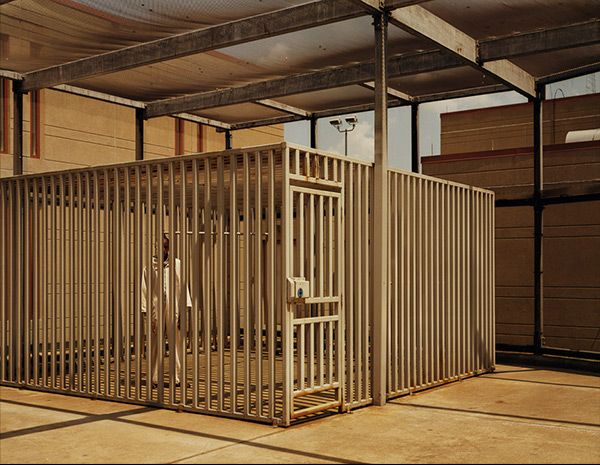 Taryn Simon, Death Row Outdoor Recreational Facility, "The Cage", Mansfield Correctional Institution, Mansfield, Ohio
Whilst engaged in the business of exposure and dispersion, it is ironic that the places she chooses to depict are often sites of restriction. In many cases she leads us up to and across boundaries, into institutions that would ordinarily remain closed to us.
At Mansfield Correctional Institution, death row inmates are permitted one hour of outdoor recreation per day in individual or group containment areas known as cages or bullpens. Inside segregated cages there is only a chin-up bar and inmates are not permitted to bring any items with them. In non-segregated cages there is a stationary basketball net and they are permitted to bring with them items including a basketball, radio, deck of cards, and cigarettes.
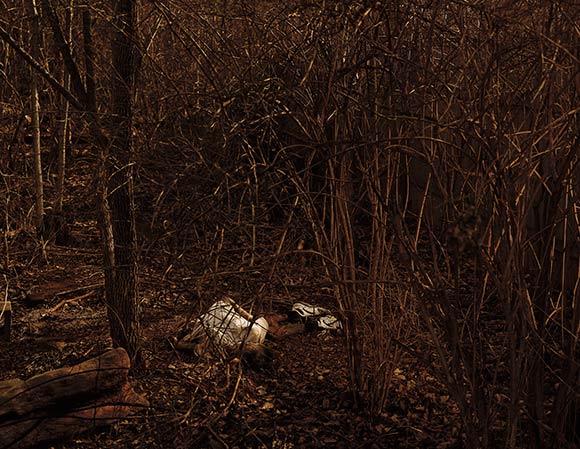 Taryn Simon, decomposing corpse, Forensic Anthropology Research Facility, Knoxville, Tennessee
Simon made her name with An American Index of the Hidden and Unfamiliar, published in 2007, a book that delves deep into a secret America in images that are often both detached and ominous: a nuclear waste storage facility in Washington State; a cryopreservation unit where bodies are frozen just after death; a bio-containment laboratory where deadly animal diseases are studied; a death row outdoor recreational cage; a cave where a sleeping black bear and its cubs are monitored by biologists studying hibernation.
She is part of a movement of relatively new kind of photography that blurs the boundaries between reportage, conceptualism and portraiture. Alongside the likes of Jim Goldberg and Paul Graham, whose work she makes work that straddles the worlds of documentary photography and fine art.
Dr Marcus Bunyan in a review of the exhibition Simon's work at the Centre of Contemporary Photography, Melbourne for the Art Blart blog says:
This is photography as documentation used to disseminate information, documentation that reinforces the indexical nature of photography (the link between referent and reality) as a form of ‘truth’ – hence the ‘Index’ in the title of the body of work, a taxonomic ordering of reality. Even then some of the photographs have to be validated by text for them to have any meaning. “The visual is processed aesthetically and then redefined by its text” trumpets the wall text.
Bunyan goes on to make a critical judgement of the quality of this body of work. He says despite their ‘hidden’ and ‘unfamiliar’ context these photographs are very dull spaces. Simon’s camera angles are by the book.
So are most of the photographs. Of course, I understand the revealing of meaning in the photograph by the text and the surprise this entails but this simply does not dismiss the fact that some of these works are just poor. In fact I would say only about 50% of these photographs could stand alone without the validation of the text. Does this matter? Is this important? Yes I think it is, for some of these works are just deadpan photographs of entropic spaces that are only given meaning because the photographer says they are important things to photograph.... Even with text some of the photographs still have no resonance.
|


