|
May 29, 2011
In Francis Bacon: The Logic of Sensation Gillles Deleuze characterizes the photograph as a ‘mould’ of time that immobilizes the instant and, in a way that remains alive to the limitations of photography, privileges a given point of view and its creation of an (institutionalized) subject.
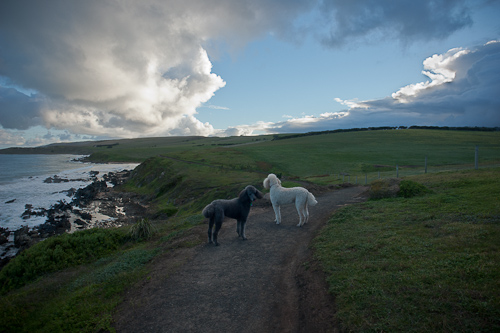 Gary Sauer-Thompson, cliff top walk, Victor Harbor, 2011
In his analysis of Bacon’s oeuvre Deleuze contrasts the possibilities of painting and photography thus:
We are besieged by photos which are illustrations, newspapers which are narratives, cinema- images, tele-images [...] Here there is an experience which is very important for the painter: a whole category of things that one can term ‘clichés’ already occupy the canvas.
Here, Deleuze plays with the double sense of cliché in French, which signifies both the snapshot and a stereotyped mode of thought: both of which require only minimal skill, time or effort and both of which freeze and limit reality.
Space is continuous and contiguous, exemplified by ‘any-point-whatever’ as the indivisibility of movement itself. Photography limits that perception, privileges certain views – of space and instants of time. Deleuze contrasts the photograph, a mould of space, with the cinematic shot: a mould of change. Whilst he sees the painting as providing the possibility of ‘the adventure of the line’ photography can only trace the ‘state of things’ rather than becoming.
Photography does not have the ability to address, treat, or disrupt the imposed objectivity and pre-disposed documentation of the mechanically-reproduced image, engender new forms of creativity, and point toward productive desires.
Is this the case? Can we think of the photographic differently to Deleuze? Can we expand the limitations of photography? Can photography be organized into various types of image? Can we think in terms of a daguerreotype that moves?
|


