|
November 8, 2011
One part of the core programme of FotoFreo12 will include a group exhibition of New Zealand photographers curated by Zara Stanhope, a curator, writer and PhD candidate at the Australian National University. It will include Mark Adams, Joyce Campbell, James Lowe, Richard Orjis and Greg Semu. It will be shown at the Freemantle Prison.
Joyce Campbell's photographic work is intriguing, especially the work that was done in the Ross Sea region of Antarctica with the Artists to Antarctica program that was sponsored by Creative New Zealand and Antarctica New Zealand.
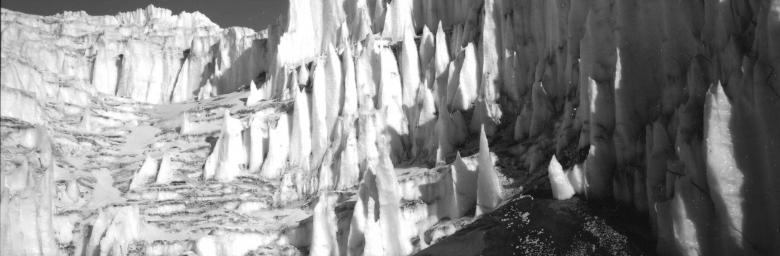 Joyce Campbell, Barne Glacier, Antarctica, 2006, Last Light
Campbell says that the work “Last Light” is a series of massive vertical photographic scrolls, panoramic photographic murals, 5x7 inch daguerreotypes and digital video loops that dwell on the Antarctica of gothic imagination: primordial, untamable and largely untouched.
She adds that the work:
was driven by my own burgeoning horror at the effects of climate change on the earths polar icecaps and it invites viewers to experience Antarctica in a volatile and precarious state: as its massive ice shelves begin to warm and melt...There is a dark irony to the growing consensus that while efforts at colonizing Antarctica throughout the twentieth century barely dented its icy surface, our collective addiction to fossil fuels, acting incrementally and from afar has gnawed deeply into the ice structures that cover the continent. The resulting unintended effect is antiheroic, grimy, disintegrative and potentially cataclysmic.
The Antarctic landscape is depicted as an alien icescape completely devoid of human objects, huge and oblivious but also replete with signs of fragility, stress and potential collapse.
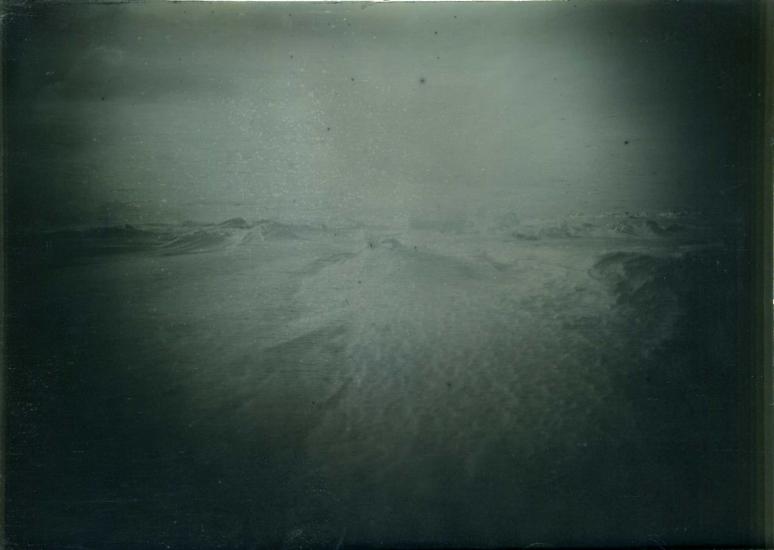 Joyce Campbell, Last Light 6 - Pressure Ridges, Antarctica, 2006,5"x7" Daguerreotype
Campbell says that the daguerreotype is an exquisite photographic technique that was essentially outmoded by the mid-nineteenth century invention of silver halide emulsion.
I have used this technique to document signs in the ice: fissures, flaws, pressure ridges and a screaming ice ghoul that emerged high in an ice fall as we descended though a white out. Because the daguerreotype’s decline preceded Antarctic exploration, it is a mode of representation that has never been practiced on that continent. In doing so now I hope to draw my audience into a conversation about modernity and obsolescence, the relationship of individual action to collective conditions and the evidentiary role of photography.
She adds that the visual references for these works are drawn from nineteenth century and early twentieth century science and exploration photography (Frank Hurley, Anna Aitken’s botanical cyanotypes, Etienne Jules Marey’s pre-cinematic time-lapses, John Adams Whipple’s daguerreotype moonscape of 1851), Romantic painting (Caspar David Friedrich and Frederic Edwin Church) and from the art, architecture and literature of the 1960’s and 1970’s, including minimalism and earth art (Michael Heizer’s geometrical earth pits, Robert Smithson’s monuments to entropy and Walter De Maria’s and Donald Judd’s expansive metallic desert installations); the optimistic modernism of Buckminster Fuller’s faceted domes, the proliferative logic of Italo Calvino’s invisible cities and JG Ballard’s drowned cities and crystal worlds.
|


