|
November 17, 2011
In Pedder Dreaming: Olegas Truchanas and a Lost Tasmanian Wilderness by Dr Natasha Cica, the Director of the Inglis Clark Centre for Civil Society at the University of Tasmania, highlights the values underpinning the art and activism of Olegas and his friends around Lake Pedder. Their voice of protest was one of beauty and nature and the text is a portal into a gallery of cameos and panoramas both actual and metaphorical depicting Tasmania as a place and a society.
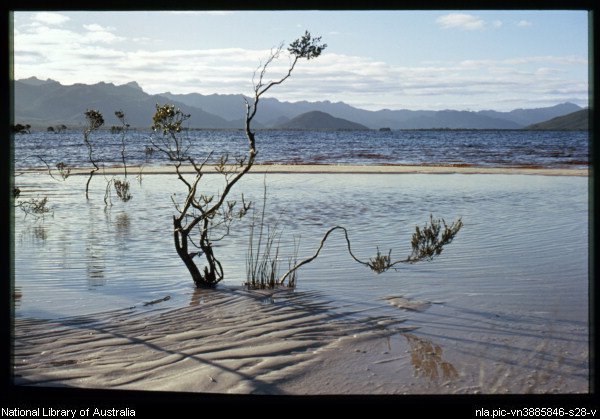
Olegas Truchanas, keletal trees throw shadows on the rippling waters of Lake Pedder, Tasmania, ca. 1968
For Tasmanians, the name of Olegas Truchanas is synonymous with the loss of Lake Pedder. As is well known Olegas spent many years exploring and photographing the wilds of Tasmania and was the first non-indigenous person to traverse many parts of the rugged interior of the island. The 1967 bushfires destroyed his home and with it virtually his entire collection of images. He set out to retrace his exploration and recording of the wilderness, but in 1972, while photographing the Gordon River as part of his mission to replace his lost slides, he was tragically drowned
He had just been offered a job teaching photography, canoeing and bush skills at the new Tasmanian College of Advanced Education, and it meant that he was able to leave Hydro Electric Commission's employment.
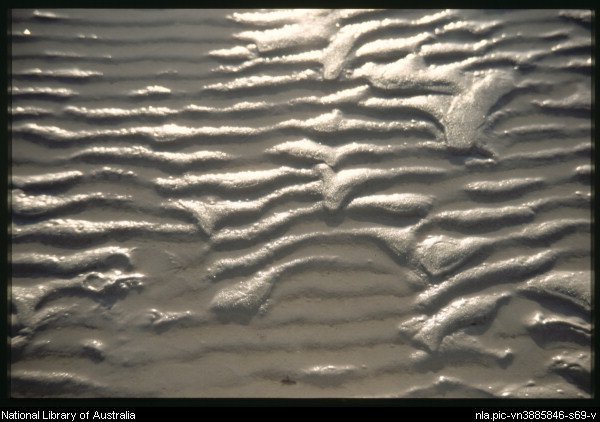 Olegas Truchanas, Changing sand patterns on the Lake Pedder beach in the early morning, Tasmania, ca. 1969
Truchanas’s artistic legacy is pioneering wilderness photography and publishing in Australia. This was then was taken up by Truchanas’ friend and protégé Peter Dombrovskis. Truchanas was a member of the ">Sunday Salon---whose roots lay in the salons of the European Enlightenment tradition which have actively promoted education, the arts, science, exploration and intellectual life generally in Tasmania. Cica recalls Truchanas’s speech at a Lake Pedder rally:
If we can revise some of our attitudes towards the land under our feet; if we can accept the role of a steward, and depart from the role of the conqueror; if we can accept the view that man and nature are inseparable parts of the unified whole – then Tasmania that is truly beautiful can be a shining beacon in the dull, uniform and largely artificial world.
That encapsulates the ecological Enlightenment
|


