|
January 19, 2012
I've started to read Philip Jones' Images of the Interior: Seven Central Australian Photographers Jones had previously published The Policeman's Eye, The Frontier Photography of Paul Foelsche (2005) The seven photographers discussed by Philip Jones in his Images of the Interior are Francis J. Gillen, Captain Samuel Albert White, George Aiston, Ernest Eugene Kramer, Cecil John Hackett, William Delano Walker and Rex Battarbee.
None of the photographers presented by Philip Jones were professionals, they were there to do a job, be it policing the district, in the case of Aiston, or telegraph operator, as Gillen was for many years at Alice Springs and Charlotte Waters. There was also a medical scientist, an artist, a doctor and a missionary. Often these men had a fair amount of spare time and used it to collect and record information for the South Australian and other Museums or to publish their research or journals. Most of White’s bird specimens were sent to John Gould in England.
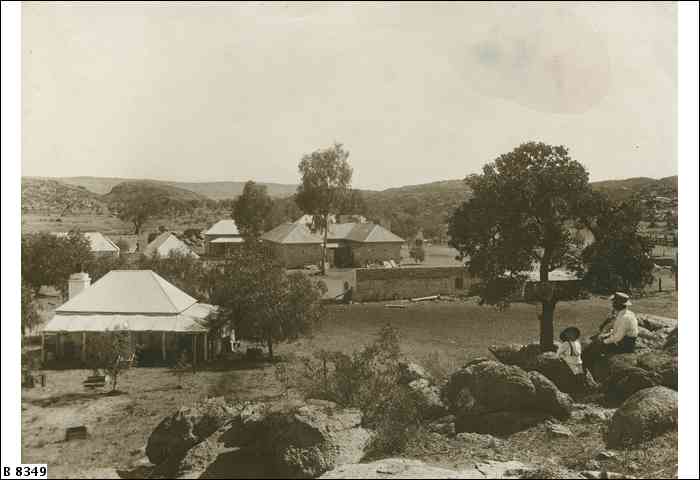 Francis J. Gillen, Telegraph Station at Alice Springs. F.J. Gillen sits right with his son Brian, 1896
Gillen was a station master at the Alice Springs Telegraph Station from 1891 to 1899 and the local magistrate in Alice Springs. He mostly photographed aboriginal people using a large dry-plate tripod mounted camera between 1894 and 1897. He produced some 400 glass negatives, and some of this work appeared in Gillen and Baldwin Spencer's text Native Tribes in Central Australia.
This is frontier photography and most of Gillen's photographs were of aboriginal ceremonies and rituals. Anthropology averted its gaze from the destruction of the aboriginal tribes of Central Australia by the pastoralists, the power of British colonialism and settler capitalism.
|


