|
January 11, 2012
Helen Ennis concludes the “Land and Landscape” chapter in her Photography and Australia thus:
And, finally, what of the vexed, interrelated matter of non-Aboriginal Australians’ sense of belonging? While the Australian historian Manning Clark speculated that European settlers were eternal outsiders who could never know ‘heart’s ease in a foreign land, because … there live foreign ancestral spirits’, it now seems plausible that non-Aboriginal Australians are developing their own form of attachment, not to land as such, but to place. Indeed, it has recently been argued that for contemporary non-Aboriginal Australians, belonging may have no connection with land at all. Perhaps this is one of the reasons why art photographs of the natural landscape have lost their currency and are now far outnumbered by photographs of urban and suburban environments - after all, it is ‘here’ that most Australians live and ‘there’ that the tourist industry beckons them to escape.”
I have been looking into though Julia Robinson and Maria Zagala's A Century in Focus: South Australian Photography 1840's -1940s which I've borrowed from the Adelaide City Library.
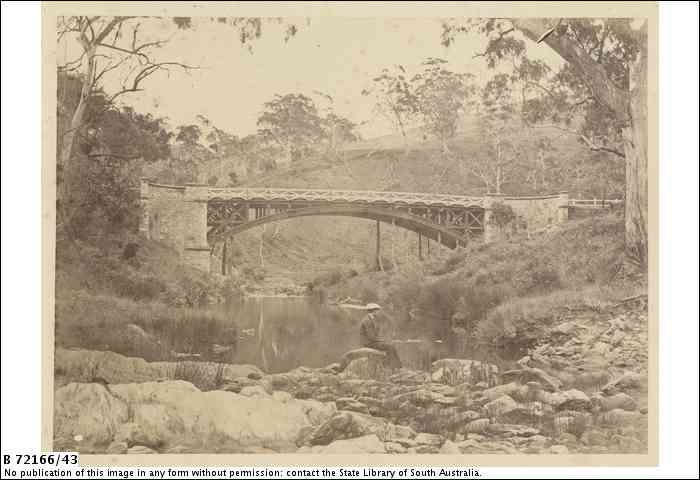 Townsend Duryea, Bridge, Gumeracha, ca.1870-1875, sepia print
Today most Australian's live in the city, but they also holiday in the bush and on the coast. Many have retired to the cost whilst some have become grey nomads exploring the Australian landscape for months at a time. Many of them would feel at home in their coastal places---as I do with respect to the Fleurieu Peninsula in South Australia.
Ennis would respond by saying that this confirms her thesis that non-Aboriginal Australians are developing their own form of attachment, not to land as such, but to place.
Settler capitalism and the sense of dislocation and the colonisation process is the past--we are talking about pre industrial capitalism that emerged in the 1950s with its modernist culture. This form, in turn, is now giving way to digital or informational capitalism. We now live in a global digital visual culture and so we look back on the colonial culture of settler capitalism in Australia as history ---its the period of from the 1840s to the 1940s in South Australia---along with its interpretation of photographic realism as a mirroring or copying. This really is the world of yesteryear.
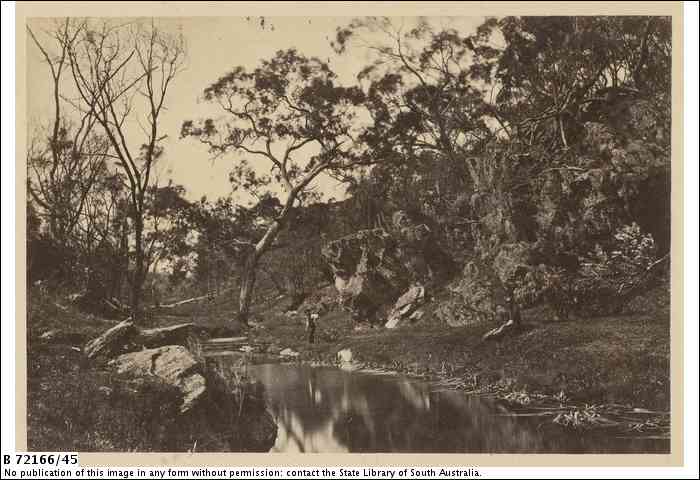 Townsend Duryea, Chain of Ponds, ca.1870-1875 , sepia print
However, land is part of place, especially along the coast. of the Fleurieu Peninsula. This is where the day tourists come to escape the heat of Adelaide during the summer.
|


