|
March 19, 2012
In the Introduction to her Tasmanian Visions: Landscapes in Writing, Art and Photography, the cultural historian Rosalyn D. Haynes refers to the category of Land Art. This avoids representing natural beauty in favour of the altered landscaped.
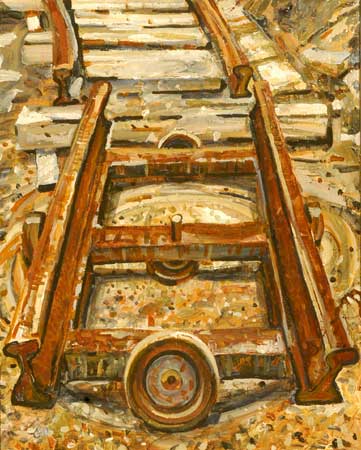 Raymond Arnold, Natural Environment and Wilderness Studies VI (2001)
The cultural context is the changing conceptions of Tasmania's unique natural environment. Haynes says:
Places formerly reviled as desolated, hostile wasteland, that drove desperate men to cannibalism and retained the moral scars, now have international status as a World Heritage Area, not only providing the State's major tourist attractions but offering the most potent source of its acclaimed creativity in photography, art and fiction.
The listing of the South-West wilderness, for instance, catapulted Tasmania from a nonentity to a key player on the international stage. Tasmania was no longer the tail-end of the world; nor was the narrative one of the pioneer's struggle for survival in a harsh land.
The emphasis of Tasmanian artists in the 1970s and 1980s was on the destruction of wilderness and the ecological damage wrought by industry by the hydro-industry and the wood-chipping forestry industry. They politicized the landscape tradition.
Photography, for instance, almost constructed 'wilderness' and how we view it: the Romantic sublime, natural beauty and landscape detail. In doing so it erased the presence of humans in the landscape; an intervention that altered the landscape. They have helped Tasmania achieve mega status as the exclusive proprietor of wilderness--pristine wilderness and it is hard for Tasmanians to deconstruct the privileging of wilderness.
This deconstruction or interrogation of place was exemplified by the Senses of Place: Art in Tasmania, 1970-2005 exhibition at the Plimsoll Gallery, Tasmanian School of Art, Centre for the Arts, Hunter Street, Hobart, Tasmania in 2006.
|


