|
July 25, 2003
In the Australian Financial Review of all places (subscription only, Review, Friday 18 July) there is a long article on Henri Cartier-Bresson, the French photojournalist and cofounder of Magnum.
Cartier-Bresson's images are so well known:
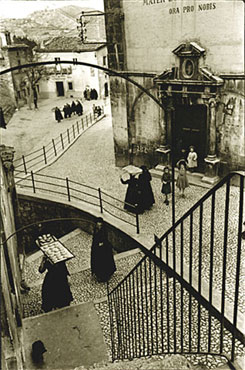
that they have become a central part of our visual tradition and historical memory bank.
You can find the interview here in the form of a review of, Henri Cartier-Bresson: The Man, the Image and the World, by John Branville.
A private foundation has been organized, a new book produced, and there is a retrospective exhibition at the Bibliothèque National in Paris.
In the lunch interview the 95 year old Henri says that he has no current interest in photography. He had given up his decisive moment photography that once captured a fleeting reality in terms of humanized geometry for drawing around 1970.
This is understandable, for Cartier-Bresson had always seen the Leica as a sketchbook for the poetic eye coded for aesthetic balance.
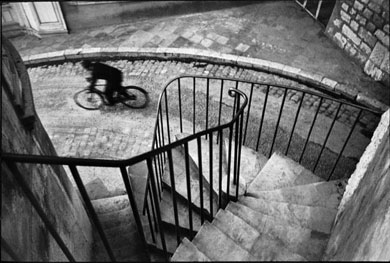
The historical image is that of the genius phtographer wandering the world intuitively discovering photographs in the historical moment. Yet he was also a photojornalist who made his living through his photos of major events.
As he was a both a photojournalist and an artist
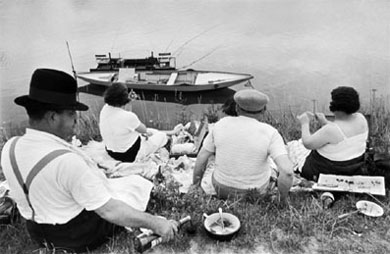
the phrase humanized geometry is apt. It is a poetics that affirms life
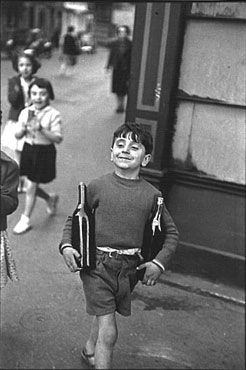
This poetics undercuts the dismissal of photography by Adorno in his Aesthetic Theory on the grounds that it is a form of copy realism that cannot account for the moment of critical opposition in art.
Adorno says very little about photography. It is limited to a few quips about the flaw of photography is that it is too attached to thing-likeness; and that photography tried to legitimate itself by clinging to the model of the portrait. It is not autonomous art as it was to tied to reality.
Photography was a different way of seeing.
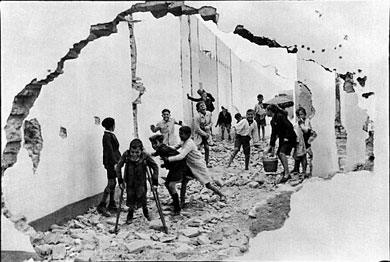
That is what Cartier-Bresson showed. It was what Adorno ignored.
For Adorno Photography was a part of the culture industry. By and large this commodity's regressive side dominates, and it is part of the new social cement of the capitalist system, rather than helping to crack the cement of the culture industry.
|


