|
July 25, 2003
The ninth part of Rick's project on Susan Sontag's Regarding the Pain of Others is concerned with the beautiful in relation to what I came to call in my last Sontag post about photography and ethical criticism as the problem of evil.
Should photographers express human suffering in terms of beautiful images? The argument that Sontag introduces holds that beautiful images of human suffering seem to trivalize suffering (evil) by taming it and making the evil disappear.
Sontag approaches this in terms of a duality. She plays off photography as art with photography outside the art institution, such as photojournalism. She says:
"Transforming is what art does, but photography that bears witness to the calamitous and the reprehensible is much criticized if it seems "aesthetic"; that is, too much like art....Photographs that depict suffering shouldn't be beautiful, as captions shouldn't moralize.
In this view, a beautiful photograph drains attention from the sobering subject and turns it toward the medium itself, thereby compromising the picture's status as a document....A photographer who specializes in world misery (including but not restricted to the effects of war) Sebastião Salgado, has been the principal target of the new campaign against the inauthenticity of the beautiful.” (Sontag, p.76-78)
I do not know the work of Sebastião Salgado, but he has an extensive body of work. You can see some of his recent work on migration here. (There are three galleries of photographs). And here is a critical review of his first Latin American work, Other America's (1986) and his second book on Latin America, Terra: Struggle of the landless (1997)
Clearly this work shows human suffering on a mass scale and it poses the problem of evil in terms of the intelligibility of the world. Why so much evil?
You look at these photos and ask, Why? Why this human suffering? Why so much suffering? The problem of evil is not something natural (eg., the Lisbon earthquake); or that it has something to do with God and the existence of evil in divine creation. What we understand from Salgado's photos is that suffering has been caused by other human beings----to the large scale forces and institutions that human beings create. Here photography is a long way from philosophy which is still caught up in escaping the theological past.
In trying to come to come to grips with suffering on a mass scale Auschwitz haunts us, as does the Gulag. We understand the machinery of death at work here.
Now Salgado's photographs are elegantly composed and he has a poetic eye. He is a first class image makers and an excellent black and white photographer. Hence the beautiful image:
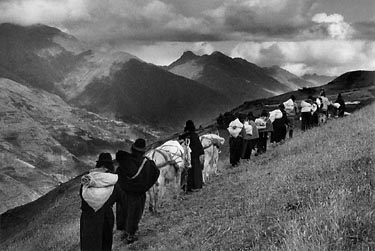
Does the beauty of the image undercut the representation of suffering?
I personally find the claim that "photographs that depict suffering shouldn't be beautiful" an odd criticism. You rarely hear the argument that a well written piece of prose undermines the depiction of suffering; that well-written prose draws attention from the suffering subject and turns it toward the medium itself.
So why is a photography different. Why does a well composed photograph----as Salgado's are----compromise the picture's status as a document? Why does a well-composed photograph---ie., a beautiful photograph---draw attention away from the suffering subject and to the medium itself?
It is not obvious that it does.
The criticism that a formally balanced image undermines the representation of suffering implies that the aesthetic is about the beautiful---ie., it is a theory of the beautiful. If form is a part of the language of art ---its inner logic--then the criticism implies a formalist aesthetic and, further, that there is only a formalist aesthetic and such an aesthetic has no content. Thus art is about itself.
It is not just the case that there is a continuum in the different kinds of photojournalism between the poles of information and expression and that that traditional (proper) photojournalism is more concerned with information and its images are documents; whilst the more expressive photojournalism becomes a fine art photojournalism in which its images are often symbols.
Two quick comments. The aesthetic cannot be reduced to the beautiful. It is also about the representation of subjects considered ugly and the sublime.
This ignores that the form of the photograph expresses the content, eg., conveying the estrangement between people through formal structures through beams and shadows that separate individuals from one another; or windows and doors that divide people rather than enable communication between them; or gazes that cross a space but do not meet. The formal structures are the language of through which a documentary photograph expresses the content.
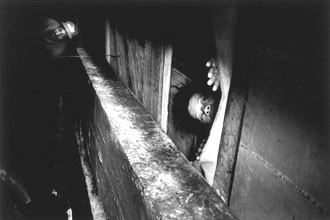
A well composed photograph expresses the content of homelessness better than a badly composed one--shapeless and lacking structure.
Moreover, the photograph does not stand alone as it is embedded in a narrative. The Migration work is about millions of people in motion, seeking survival and a better life -- leaving the land for the cities, living in refugee camps:

and then living in impoverished conditions in the cities.
The indicates that the individual photograph is placed within an interpretative framework that makes sense of the accumulated meaning of the series of phootgraphs by providing an articulated historical context for the reader.
|


I think suffering aesthetically put is more effective coz of the contrast. that mankind has the gall to waste his creativity and nature's bounty just to fufill his greed and selfishness