|
September 4, 2004
By and large the history of Australian art has been dominated by the landscape, despite the embrace of abstraction in the 1960s and the conceptual in the 1980s.
The landscape tradition is not redundant. It cannot be avoided: it can only engaged with.
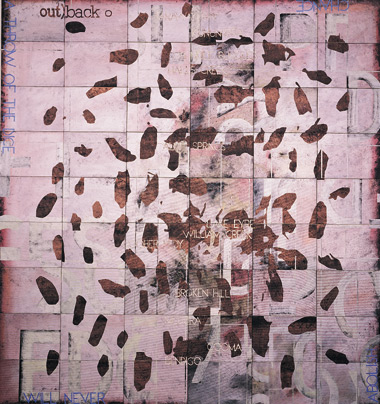
Imants Tillers, OUT)BACK 0, 2004
Tillers is a case in point. He has found most of his images in art magazines and catalogues because this is the way that most Australians view art due to their geographical remoteness. That implies European and American art. The use of the technique of appropriation is to invert the outmoded, if still prevailing order of centre to province, coloniser to colony, overlord to underdog, and to assert the artist's identity.
But what about Australian art? We are not geographically remote from that. There is something called Australian art with a unique range of concerns and loads of potential energy.
Do we not view art through the lens of our locality--our own landscape tradition? Do we not inhabit place (topographical) and experience place?

Imants Tillers, Nature Speaks Be, 2003
Is not our understanding of Australian modernity is tied to the landscape as much as it is to the machine?
However, the landscape tradition has been defined as parochial when compared to the European avant garde. The classic contrast is:
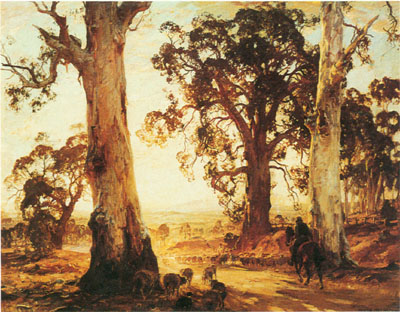
Hans Heyson, Droving into the Light
vs

Marcel Duchamp, Bride Stripped Bare by her Bachelors Even
(The Large Glass), 1915-23
Hence Australians are locked into a parochial provincial bind.
Really? What about the Aboriginal renaissance in art of the last 30 years? Does that not break up that duality?
|


