|
November 20, 2005
Art is often seen as the viewer experiencing pleasure in the beauty of a particular object. 'Experiencing' involves sensation, taste, reflection and judgement that are held to be apart from our practical, moral or political interests. Those who write about aesthetics and know their Kant talk in terms of the 'autonomy of aesthetic judgement.'
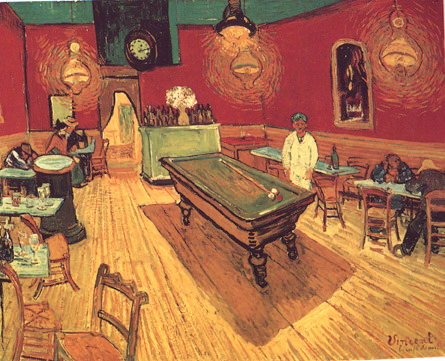
Vincent Van Gogh, The Night Cafe, 1888
Kant famously divorced the true (knowing) from the good (right action) and the beautiful and turned them into autonomous forms of discourse. Many have made Kant's grammar of aesthetics their own, embraced art's alienation from knowlege and morality, celebrated the historical emergence of autonomous art and aesthetics, and held that an modernist formalism is the high point of modernity.
So we can speak of the end of art in the sense that art is no longer for us the palce where truth occurs and is no longer formative of our experiences of ourselves and the world. Art is displaced from the centre to the periphery --as did religion in the transition to modernity.
So the overcoming of aesthetics can be interpreted as a twisting free from being imprioned in aesthetic modernity and a restoring to art works their status as forms of knowledge and ethics grounded in a community (sensus communis).
Can we engage with art in a manner that transcends the circumspection of art in pleasure and beauty and outside knowledge and ethics?
|


it is very much possible, but, it's a different kind of pleasure, isn't it?