|
May 19, 2007
We can think of Hanson Bay on Kangaroo island as a "place world" in terms of a phenomenology of place; a phenomenology that begins with Husserl’s lifeworld, passes through Heidegger’s existential emphasis on space, then incorporates Merleau-Ponty’s body-centric account of world. Edward Casey’s work Getting Back into Place (1993) and The Fate of Place (1998) are guiding texts, with the former primarily defining place against time, whilst the latter defines place against space. Spirit and Soul (2004) provides a history of Casey’s thinking on place.
Online resources include Bruce Janz’s Research on Place and Space website and David Seamon’s Environmental and Architectural Phenomenology site.
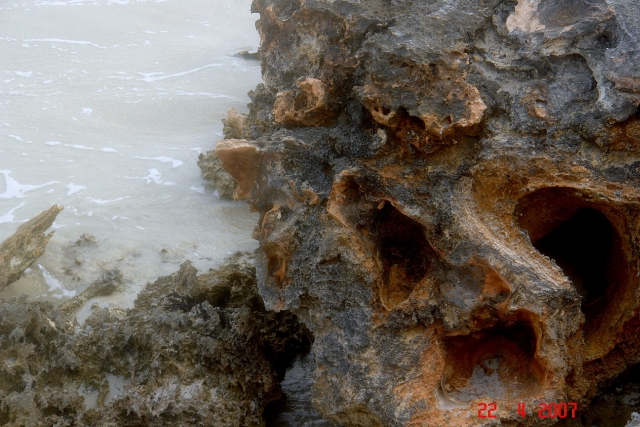
Gary Sauer-Thompson, seashore, Hanson Bay, Kangaroo Island, 2007
The experience of a place such as Hanson Bay is different from the standard understanding of a regional built urban industrial place (eg., Adelaide) as a movement of a logic of loss, and its impetus toward a resistance, that is based on place -memory and personal identity, against those strands of modernity, such as mass communication, global capitalism, and mass culture that engender the production of homogenous and atemporal "flatscapes".
In opposition to international shopping malls, airports MacDonalds and Starbucks we have a defining embeddedness in the density of history and locality.
Hanson Bay was not a sheer spatial site detached, abstract and entirely devoid of intimacy. It is a memorable wild place---wilderness is understood as that place where one loses one's way, becoming bewildered in a starkly "alien world". On the other hand, the very concept of wilderness is a human construct, meaningful only in relation to people.
|


