|
May 29, 2008
The Spooner cartoon is a bleak image. But peak oil, reduced water, climate change, inflation (high food prices) and more expensive energy are taking their toll on us and portend a different kind of future to the endless prosperity promised by neo-liberal economics. So we have the sense of a dis utopia--what the gods have mysteriously delivered to us they could easily take away as it were.
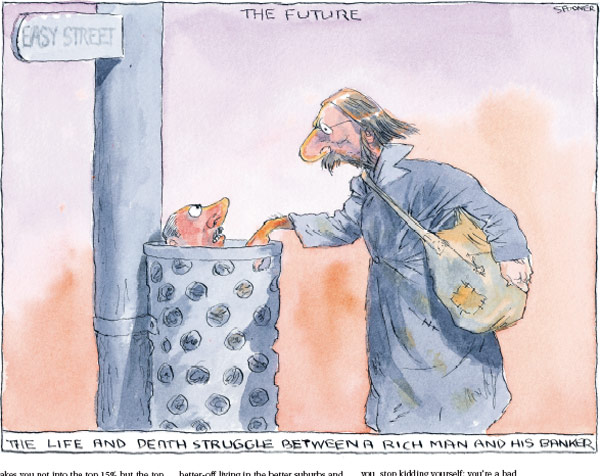 Spooner
If our cities are places of encounters can we talk of the loss of a location for the critical potential of reason? The negative can be reinterpreted to form the basis of a critique of business-as-usual, the fine sounding words and little action, the policies written by the powerful interest groups (eg., the Greenhouse mafia) and the hegemony of instrumental reason.
The latter refers to the positivist variant of rational thinking (a classification of facts within mathematized formulas) that defines itself as rational thinking as such, and as a structure of knowledge concerned with the technically useful and which serves productivity through increased control over natural processes.
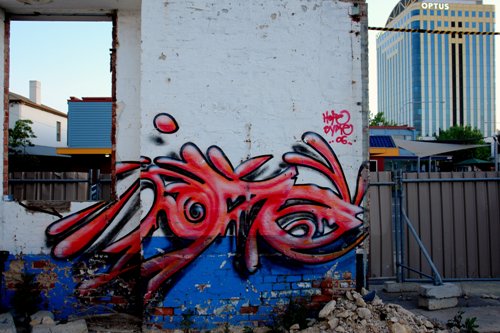 Gary Sauer-Thompson, building site, Adelaide CBD, 2007
Can we critique the positivist Enlightenment from an aesthetics of decay? Can we look at the world created by the positivist Enlightenment and neo-liberalism from the perspective of the waste and destruction that it causes in its normal everyday workings? Can this location in an urban wasteland provide a space to express those experiences and unfulfilled demands that are routinely dismissed by positivist economic reason as junk?
|


