Thought-Factory.net Philosophical Conversations Public Opinion philosophy.com Junk for code

Mandy Martin, Puritjarra 2, 2005. For further information on MANDY MARTIN, refer here: http://www.mandy-martin.com/
If there are diverse kinds of knowledge and ways of knowing place, then we need to learn to value the different ways each of us sees a single place that is significant, but differently so, for each perspective.
RECENT ENTRIES
SEARCH
ARCHIVES
Library
Thinkers/Critics/etc
WEBLOGS
Australian Weblogs
Critical commentary
Visual blogs
CULTURE
ART
PHOTOGRAPHY
DESIGN/STREET ART
ARCHITECTURE/CITY
Film
MUSIC
Sexuality
FOOD & WiNE
Other
www.thought-factory.net
looking for something firm in a world of chaotic flux

Eric Tabuchi: abandoned Gasoline stations « Previous | |Next »
March 10, 2009

Eric Tabuchi's work---26 Abandoned Gasoline stations ---is a representation of abandoned, rusting, toxic-leaking architectural ruins that blight the landscape and roadscapes of France. Tabuchi photographed these abandoned gasoline stations between 2002 and 2008 in a flat, objective style, showing them just as plainly as they exist.

The pictures signify the decline of an auto civilization based on cheap petrol.
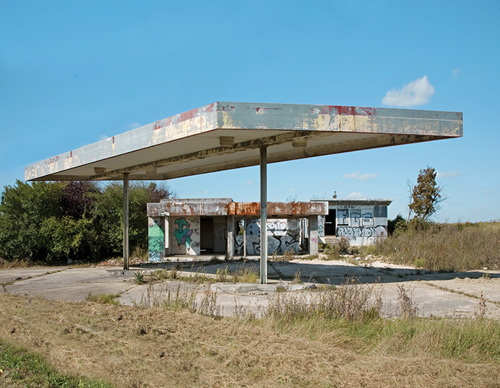
Tabuchigasoline_11.jpg Eric Tabouchi, Station #11, from the series 26 Abandoned Gasoline stations, circa 2002-2008

The art photography reference is to Twentysix Gasoline Stations, one of the first American artist books, by the pop artist Ed Ruscha. The book was a small paperback containing pictures of gas stations dotting U.S. Route 40, the road between Oklahoma City, where the artist grew up, and Los Angeles, where he lived and worked in the 1960s. It had minimal text and was arranged so that the reader's progress through its pages is similar to a traveler's journey from Los Angeles to Oklahoma City and back.

Ruscha's book was the Pop-Minimalist vision of the Road. Jack Kerouac had written about the ecstatic, beatnik Road. Ken Kesey and Neal Cassady had written about the acid-hippie Road. Ruscha had photographed the road through realms of absence - that exquisite, iterative progress through the domain of names and places, through vacant landscapes of windblown, ephemeral architectural language.

Photography books have become a natural extension to the photographic process, and are shaping the future of photography as we know it. Long gone are the days where only professional and internationally renowned photographers could publish their work. With print on demand technologies, all photographers can create bound collections of their work, while retaining full control of the creative process – forever changing the face of publishing.

| Posted by Gary Sauer-Thompson at 7:35 AM | | Comments (2)
Comments

Comments

Ruscha's Twentysix Gasoline Stations was a playful and cryptic visual combination of architecture and landscape, as well as his ability to "look at" what most of us "look through" on the road.

I forgot to add that the artist book---a cheap, mass-produced and exalting the idea, rather than the quality of the materials, printing and binding of coffee table photography books---was innovative in the US in the 1960s.

An earlier example was Guy Debord and Asger Jorn's two collaborations, Fin de Copenhague (1957) and Mémoires' (1959), two works of Psychogeography created from found magazines of Copenhagen and Paris respectively, collaged and then printed over in unrelated colours

Ruscha's book is directly related to American photographic travelogues, such as Robert Frank’s The Americans' (1965), but deals with a banal journey on route 66 between Ruscha's home in LA and his parents' in Oklahoma. Ruscha chose to distribute the original edition in the gasoline stations that he'd photographed, thereby completely bypassing traditional means of dissemination within the artworld. Ruscha created a series of homogenous books throughout the sixties, including Every Building on the Sunset Strip, 1966 and Royal Road Test, 1967.

I can recall going into an exhibition at the EAF in Adelaide that featured nothing except a stack of artists' books. It was part of the Conceptual Art movement, that was pa reaction against formalism as it was articulated by the iNew York art critic Clement Greenberg. Conceptual art used the artist's book as a central part of their art practice that explored the concept(s) or idea(s) involved in the art work, which took precedence over traditional aesthetic and material concerns.

From memory it had something to do with the Art and Language group --the Australian practitioners were Ian Burn and Terry Smith. They dealt with questions surrounding art production, and attempted a shift from the conventional "non-Linguistic" forms of art like painting and sculpture to more theoretically based works. They argued against the formalist views of Clement Greenberg and Michael Fried.