|
March 3, 2009
The word Psychogeography' comes from DeQuincey's wanderings, slightly druggy, no pattern, mapping out the city in a dream-like state. Then with Walter Benjamin and the Situationists the term becomes more a matter of taking very conceptual decisions about the walking you would do and how you would access the city like that. So says Ian Sinclair. He forgets to mention both Friedrich Engels', On the Condition of the Working Class in England that was based on his detailed descriptions of his walks around Manchester in the 1840s and the Surrealists dérive, the aimless drifting, the idea of following your unconscious drives to walking across the city.
How is this different from just wandering the street, sitting in cafés and watching the world go by whilst chatting to friends over coffee? Sinclair says:
For me, it's a way of psychoanalysing the psychosis of the place in which I happen to live. I'm just exploiting it because I think it's a canny way to write about London....I can't live in Hackney. ... Nothing working, completely shot council, the banality of gradual dysfunction, the sense of the landscape becoming more intimidating.
Still he writes about it, describing what has happened to London and it environs over the last few decades, thereby drawing people’s attention on what’s happened to the city. Why not photographers doing this? After all, we Atget’s city and his photography of old Paris.
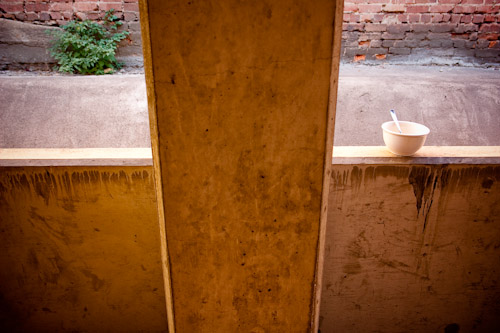 Gary Sauer-Thompson, Young Street carpark, 2009
After all, psychogeography is the point where psychology and geography meet in assessing the emotional and behavioural impact of urban space. The relationship between a city and its inhabitants is measured in two ways - firstly through an imaginative and literary response, secondly on foot through walking the city, which is what I do daily. like the recitation of an urban myth, pushing the boundaries of the plausible. Under the physical erasure of urban planning that works hand in glove with developers the city’s past takes refuge in receding memory, often appearing through urban legend.
Merlin Coverley, who has written a book on Psychogeography, says that:
History shows that through literature there is a particular way of responding to the city and its environs. Many ways really, but there is one common theme: that if you scratch beneath the surface you can find something else: the different layers, the mapping, the essence of any city is in its oddities, its peculiarities, the particularities of its places, a sense that all this is being continually erased, not just in London, but everywhere, globalisation in particular. There is a sense that this is happening and people are buying into it without any real awareness of what’s being lost in the process.
Psychogeography provides us with new ways of apprehending our surroundings, transforming the familiar streets of our everyday experience into something new and unexpected in a globalised world. Sinclair tackles spatial change and politics within cities at a time when the welfare state is being destroyed and the dream of London’s municipal socialism is being crushed by Margaret Thatcher.
|


Sinclair says in this text that he's been doing what everybody else has been doing for years. Now there’s a convenient label, a franchise, psychogeography:
Sinclair also refers to his debt to the Kerouacian notebook idea’. How he’s an observer, but also a participant in what he observes, ‘a ghost in his own work... in the landscape to a greater or lesser degree’. This includes referencing his writer friends, myth- building, as Kerouac did.