|
January 28, 2010
Tony Bridge, the New Zealand photographer is based in Canterbury in the South Island. He divides his time between assignments as a professional commercial photographer, writing and running workshops, both in New Zealand and abroad, as well as developing his art photography.
A graduate of Canterbury University in Christchurch (a degree in foreign languages and literature), he is primarily a landscape photographer, runs an interesting a photographic blog, and, like myself, uses a Sony DSC R1 digital camera as his lead documentary camera. Unlike myself he has several lead (full frame) digital cameras. He runs photographic workshops in the Maniototo district in Central Otago and Lake Waikaremoana in the Te Urewera National Park on landscape photography.
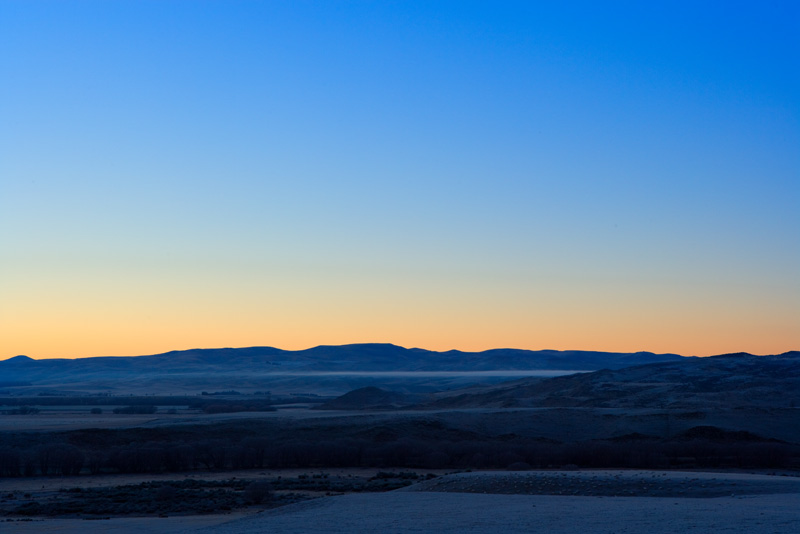 Tony Bridge, Maniototo district of Central Otago, New Zealand c 2007
His work is based on using computer software to add layers of meaning and subtlety that enables him to make the crossing from the documentary tradition of photography to the expressive potential of mark-making with a camera and computer. He is both a digital artist and photographer.
In this Beating the drum post he says:
I made the image, knowing that it was merely about capturing the necessary data for later post-production. A feeling was forming about how the scene in some way represented my own journey, and a certain confusion about future direction. I captured the data, knowing that post-production would enable me to extract the meaning from it at a later time. Working in post, and applying a series of techniques (around 10 separate layer adjustments), I was able to find the kernel of realisation the image contained. Was it photography? Of course not. While the device I used to capture the data bore a striking resemblance to the device I might have used to document it for a seed company, the intent was completely different.
The argument is that post-production opportunities offered by image editing software mean that we can step beyond those limitations of film photography:
If we are willing to factor in our imagination and give it free rein, we are able to expand space, time and expression, and make pictures rather than take them. We have the ability to create freely and share our worldview and increasingly novel ways. ....To do this, we need a truly unique source of ideas, a source unlike any other. Ourselves. Each one of us is a completely unique individual, with a singularly original range of experiences upon which to draw.
This appeal to the Romantic tradition, to the creative process, poetic feeling, and the primacy of the creative imagination. Romantic photography seeks to bring the supersensible back into the realm of sensuous representation.
Bridge says that his expressionistic work, which represents his feelings when in the landscape, is about beauty. However, many of his heavily colour saturated images are of the dark moody skies, dramatic light, and stormy conditions that suggest the Romantic sublime is in play. However, the sublime is not sundered from the beautiful in Bridges work; sublimity is regarded as a mode of beauty, not as an
exception.
Broadly speaking, the category of the sublime refers a moment whenever experience slips out of conventional understanding,whenever the power of an object or event is such that wordsfail and points of comparison disappear. As such, the sublime marks the limits of reason and expression together with a sense of what might lie beyond these limits.
When uncoupled from the Judeo-Christian concept of the divine, the sublime is figured in postmodern thought as immanent rather than transcendent---to ‘that within representation which nonetheless exceeds the possibility of representation’. For Bridges the sublime is more conventional as it is an indicator of a higher or spiritual realm, or the divine and its concepts of reverence and awe.
|


the sublime has a history in aesthetics --and so there are many kinds of sublime. William Shaw in The Sublime says:
The sublime is usually related to ideas of the great, the awe-inspiring and the overpowering.