|
January 27, 2010
I mentioned John O' Malley, the ChCh based New Zealand photographer, in passing in this post about Castle Hill Basin in Canterbury, New Zealand. In his art photography he is primarily a landscape photographer and he recently had an exhibition at COCA in Christchurch entitled Sentinels/Crossings.
Crossings explores the relationship between rural railway road signs and their surrounding environment:
 John O' Malley, 'Craigieburn Rd #1', Digital image printed with archival pigment inks
The Craigieburn Range of mountains is located on the south banks of the Waimakariri River, south of Arthur's Pass whilst the Craigieburn Valley ski slopes are within an hour and a half from Christchurch. What is represented here can be interpreted within the New Topographics tradition of human altered landscapes.
In this case it is the transport networks of the 19th and 20th centuries ---the railways and roads ---that traverse the landscape and their various signs signifying their presence. They are about a place and time, rather than the beauty of the natural landscape, as can be found in photographs of snow-clad mountains and gentle beaches with golden sand and teal-coloured water.
In contrast, the Sentinels series examines the landforms and rocks of the Port Hills that lie between Christchurch and Lyttelton. This body of work is more in the tradition of wilderness photography and its concerned with the beauty of the landforms and rocks in this volcanic landscape. An example is O' Malley's Sentinel #4'
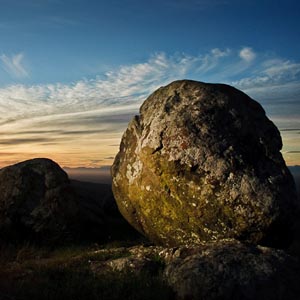 ' '
There is little hint of human intervention in the landscape and there is no attempt to move to an abstraction of nagture. The concern is with the beautiful as it relates to notions of unity and harmony and there is no attempt to shift to the sublime refers to fragmentation and disharmony, to the moment when thought trembles on the edge of extinction. In this work the beautiful is prevented from slipping into the merely agreeable.
What is unclear from the photos is whether O'Malley is trying to show and share the beauty he discovers in these landforms, or whether he is finding in nature an expression of an abstract ideal of beauty that is in his mind; expressing his feelings about the beauty and mystery of nature.
Can the two series be juxtapositioned to one another? The exhibition invites such a reading. This gives us a civilization v nature narrative. What then is the relationship between this duality? Is it one of opposites?
It is not simply one of the degradation of nature by human beings versus the beauty of nature as the images in the Crossings series can be interpreted as beautiful, rather than the sublime or ugly.
|


